Bicycle stainless steel tube bending machine and steel frame pipe processing technology
News 2026-10-22
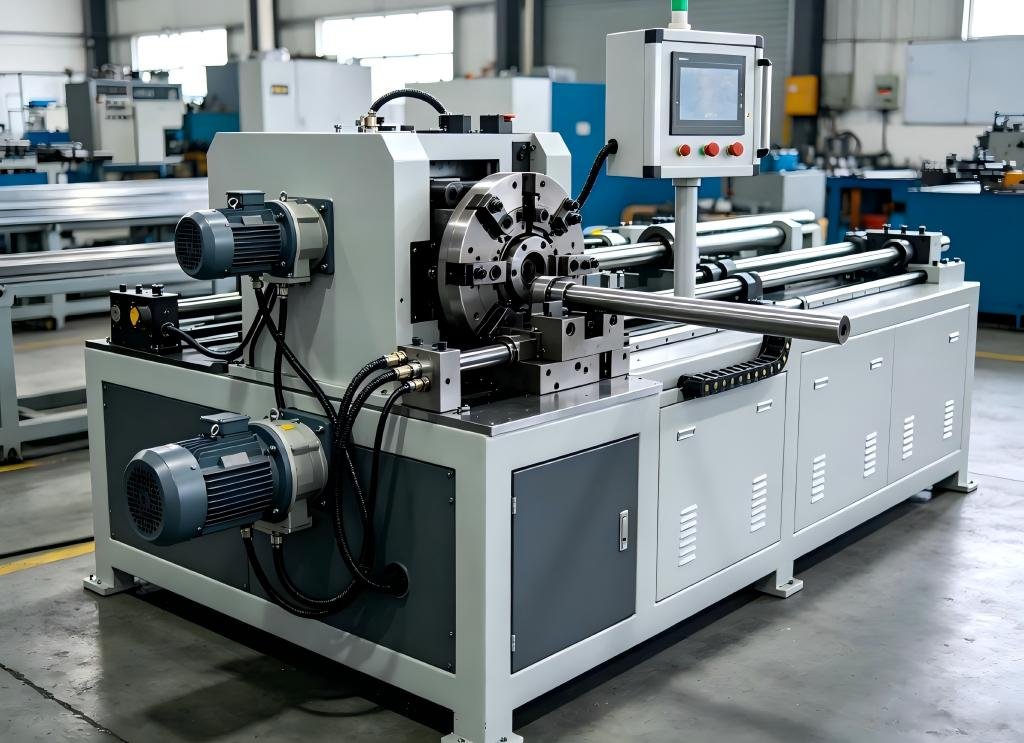
Tube benders are core equipment for metal tube forming. Their power systems mainly fall into two categories: fully hydraulic drive, and combined drive of hydraulics with servo systems. Equipped with high-power hydraulic units or servo control systems, these machines can steadily perform fixed-angle bending and forming of various metal tubes. Thanks to their outstanding processing adaptability, tube benders are widely used across numerous manufacturing sectors, including auto parts fabrication, motorcycle frame manufacturing, shipbuilding, boiler and pressure vessel production, electrical power equipment, rail transit, fitness equipment, air-conditioning and refrigeration piping, bicycle frame manufacturing, metal furniture, and sanitary pipe fitting production.
Controlled by a numerical control system with a user-friendly human-machine interface, the machines feature intuitive and simple operation workflows for faster and more convenient commissioning and production. Multiple mainstream types of tube benders are available to match different profile materials and forming process requirements. Among them, models dedicated to bicycle frame fabrication serve as a critical link on steel bicycle frame production lines.
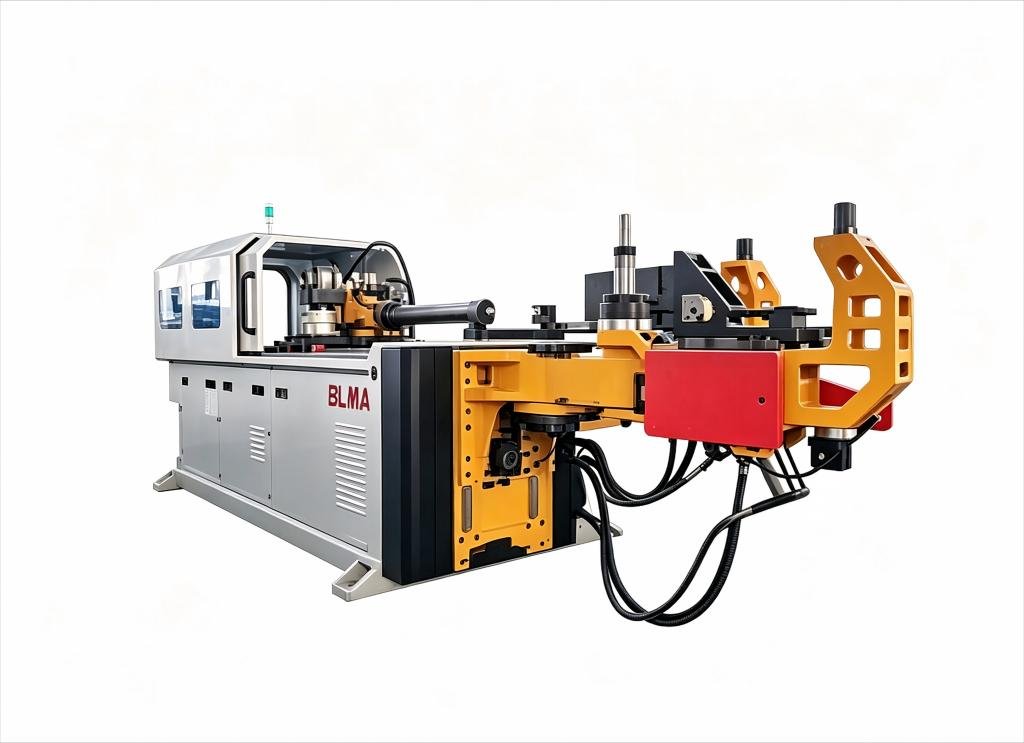
Single-head tube benders are widely adopted basic bending machines, suitable for processing tubes with one or multiple bending angles within a single plane. The maximum wall thickness each model can handle varies by specification. For high-frequency welded tubes of the same outer diameter, the wall thickness is generally limited to 2.0 mm or less. Stainless steel has high hardness and is harder to bend; when processed on a single-head tube bender, its wall thickness usually does not exceed 1.2 mm. Aluminum and copper have better ductility, allowing an additional 1 mm of wall thickness compared with stainless steel. Common single-head tube bender models on the market include 38, 50, 65, 75, 85 and 100. Manufacturers select suitable models according to the outer diameter and wall thickness requirements of frame tubes.
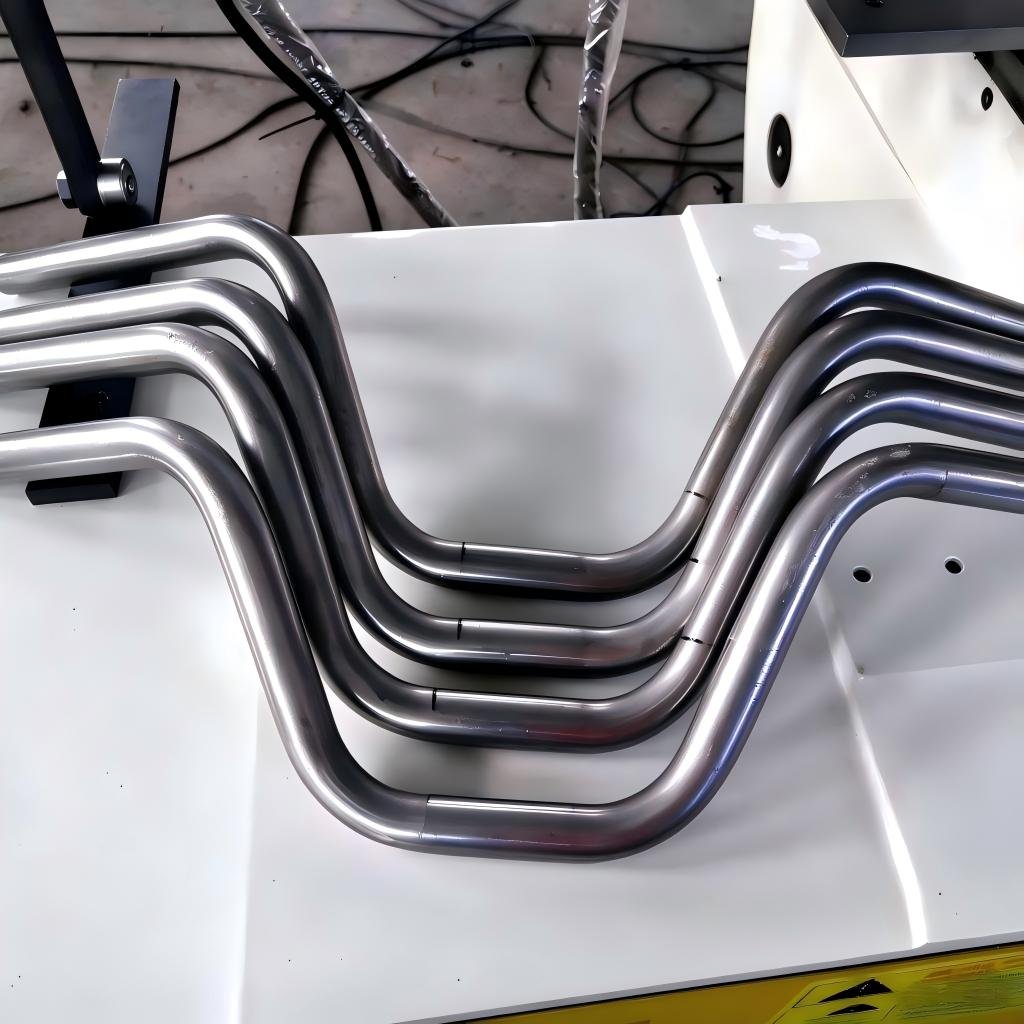
Electric tube benders adopt an all-electric structure. Motors paired with speed reducers drive bending movements via gears and chains. With a simple structure, they are fit for low-difficulty planar tubular parts with moderate precision requirements.
CNC fully automatic tube benders are the primary choice for frame factories upgrading production lines, featuring servo rotation and servo feeding functions. A workpiece only needs one clamping setup to complete continuous multi-angle bending in three-dimensional orientations. These machines are specially designed for complex 3D tubular parts that do not lie on the same plane, making them the key production equipment for bicycle frames and special-shaped tubes. Fully automatic tube benders are subdivided into three main types: electric tube benders, hydraulic tube benders and CNC tube benders.
Hydraulic tube benders use hydraulic cylinders to drive clamping and release, bending and return, auxiliary pushing in and out, and mandrel advance and retraction. They are conventional planar wrap-around automatic bending machines. While the bending action is automated, feeding length and 3D rotation positioning mostly rely on stop gauges with manual assistance, making it difficult to process complex multi-angle spatial frame tubes.
For CNC tube benders, servo motors control core procedures including feeding, tube rotation, bending travel, auxiliary pushing and head lifting. Clamping and mandrel movement are still driven by hydraulics or pneumatics. Compared with traditional hydraulic tube benders, their biggest advantages are continuous processing capability and high forming precision. They easily realize 3D tube forming and perfectly meet the processing demands for complex tube profiles of bicycle frames.
For steel-framed bicycles, there is a well-known saying in the industry: Material accounts for 30%, and craftsmanship accounts for 70%. The base tube material lays the foundation for the frame’s final ride feel and durability, while tube forming, welding and post-treatment processes define its upper performance limit. In the global steel tube sector, two long-established renowned manufacturers are Italy’s Columbus and the UK’s Reynolds. Both brands have launched many classic tube series, such as Columbus SLX and Reynolds 531, which remain familiar to steel frame enthusiasts to this day.
Tubes commonly used for bicycle steel frames are mainly divided into two grades: high-tensile steel (HI-TEN) and chromoly steel (CR-MO). High-tensile steel has high density and low cost, mostly used for ordinary commuter bicycles. Chromoly steel supports butting processes and delivers excellent toughness and strength, making it the preferred material for performance steel bicycle frames. As an alloy steel, chromoly steel adjusts its material properties by adding elements such as nickel and vanadium, giving rise to a wide range of sub-grades.
Lightweighting of steel frames is mainly achieved through tube butting, which means varying wall thickness along the tube according to force distribution. Common variants include double-butted and triple-butted tubes. Thicker walls are applied at tube ends that bear greater loads, while the middle low-stress section is made thinner. Cutting-edge technology can reduce the thinnest section of a tube down to 0.2 mm. Tubes from different brands and series have distinct mechanical parameters and tuning orientations. Take Reynolds 853 as an example: it is a high-hardness steel tube. Many frame makers do not build the entire rear triangle out of 853. Instead, they pair it with more ductile tubes such as those from the US brand True Temper to balance frame stiffness and ride comfort and filter road vibrations.
Modern steel frame tubes behave noticeably differently from vintage tubes during welding. Early tubes suffered obvious deterioration in hardness and mechanical properties after welding, so low-temperature silver brazing was widely adopted then to preserve the original tube strength. New-generation tubes feature optimized welding characteristic curves; their hardness increases after bronze brazing or TIG welding, and low-temperature silver brazing has gradually faded out of mainstream frame production.
The two dominant welding methods for modern steel frames are lugged brazing (LUG) and tungsten inert gas welding (TIG). TIG welding has a low learning barrier and simple workflow, now the most widely adopted welding method in frame factories. Lugged brazing forms joints with bronze welding and extra socket lugs, which add frame weight. Its positioning, assembly and commissioning procedures are cumbersome, so its application is declining. Frames marked True Temper use tubes sourced from this professional American tube manufacturer. Many unmarked steel frames use domestically produced tubes, most of which are non-butted and result in heavier complete bikes. A small number of domestic butted tubes still lag behind imported counterparts in material performance.
The first step in selecting a steel bicycle frame is verifying the tube material. Tubes embody the metallurgy and butting technology of their material manufacturers and directly determine the frame’s baseline stiffness and damping feel. Special-shaped tube profiles are essentially another approach adopted by tube manufacturers to boost structural strength by modifying cross-sectional geometry. Once tube specifications are finalized, frame factories select materials according to product positioning. Reynolds 631 and 520 are original tube series from Reynolds, while Jamis is only a frame OEM responsible for tube welding and forming — the tubes themselves are not Jamis proprietary products. For famous tubes such as Reynolds 853, the cross-section, butting specification, weight, strength and other parameters are predefined by the tube supplier. Frame builders simply select matching tubes based on ride positioning. Different tubes have unique stiffness, toughness and deformation curves, which lie at the core of frame design and tuning.
Besides frames built with well-known imported tubes, old stock steel frames occasionally appear on the domestic market, such as Jamis frames built with Reynolds 631 tubing. Globally, the market share and shipment volume of steel-framed bicycles have been gradually squeezed by aluminum alloy and carbon fiber frames, a major industry trend. Nevertheless, steel frames retain a stable community of enthusiasts thanks to their smooth ride feel, retro aesthetics and repairability, and they will not disappear completely from the bicycle market anytime soon.
Tubing and tube profiles are only the starting point for choosing a steel frame; frame fabrication craftsmanship is equally critical. Weld uniformity, post-weld finishing quality, tube joint treatment and surface coating texture all directly affect appearance, rust resistance and service life. This reinforces the old adage once again: for steel frames, Material accounts for 30%, and craftsmanship accounts for 70%. As the core primary equipment for forming frame tubes, stainless steel tube benders for bicycles determine whether tubes can be bent into smooth, standard angles free of wrinkling or collapsing at bending points. They directly impact the finished quality of subsequent welding and assembly, and are indispensable special processing equipment for stainless steel and steel bicycle frame production.