Stainless Steel Tube Bending Machine Buyer’s Guide: CNC, Hydraulic, Automatic and Semi-Automatic Solutions
News 2026-09-08
A stainless steel tube bending machine should be selected according to the parts it must produce, not only the maximum tube diameter shown in a catalog. Material grade, wall thickness, centerline radius, bend sequence, surface finish and production volume all influence the required machine, tooling and automation level. A correct selection can reduce wrinkles, flattening, springback errors, scrap and downstream assembly problems.
This buyer’s guide compares CNC, hydraulic, fully automatic and semi-automatic bending machines. It explains the technical data a supplier needs, the role of bending tools, quality acceptance and total cost. It also introduces Jiuqiang tube bending solutions for stainless steel and other metal tubing used in automotive, exhaust, furniture, bicycle, shipbuilding and general fabrication.
What Is a Stainless Steel Tube Bending Machine?
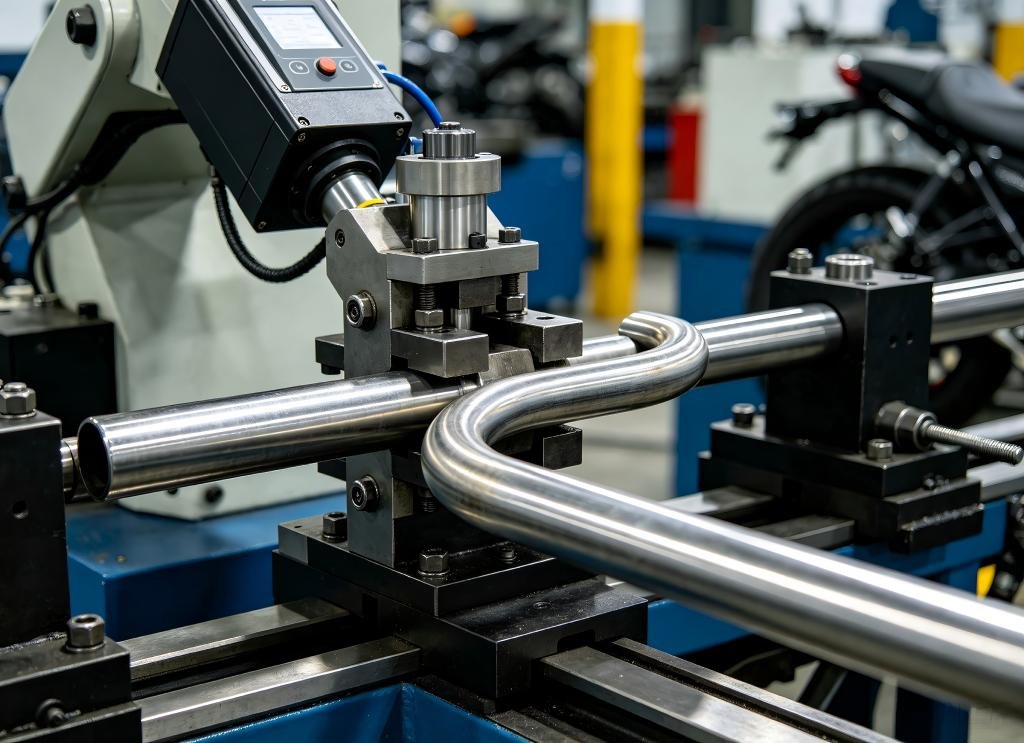
A stainless steel tube bending machine applies controlled force to form straight tube into a specified angle and radius. Depending on the process, the machine may also feed the tube to an exact length, rotate it to a new plane and create several bends in sequence. Rotary-draw bending is common when the part requires a defined radius, good repeatability and close dimensional control.
During rotary-draw bending, a clamp die holds the tube against a rotating bend die. A pressure die supports the straight section. For thin-wall tube or a tight radius, an internal mandrel supports the cross-section and a wiper die controls compression near the tangent. Machine motion, tool design, material consistency and setup quality work together; one cannot compensate indefinitely for a problem in another.
Other methods have different uses. Roll bending forms large, sweeping radii and rings. Compression bending can be suitable for simpler shapes. Press bending is economical for some robust parts but offers less cross-section control. Buyers should confirm that the proposed process matches the geometry and finish required by the finished component.
Why Stainless Steel Requires Careful Process Control
Stainless steel is valued for corrosion resistance, strength and appearance, but these properties can make bending demanding. The material often has significant springback. The outer wall stretches and becomes thinner, while the inner wall compresses and may wrinkle. Thin-wall tube can flatten, and a polished surface can be damaged by dirty, worn or unsuitable tooling.
Different stainless grades and tube manufacturing methods can behave differently. A program developed for one grade or material batch should not automatically be assumed to produce the same result with another. Outside diameter, actual wall thickness, mechanical properties, weld seam and surface condition should remain within the agreed purchasing specification.
The relationship between tube diameter, wall thickness and bend radius is especially important. A tight centerline radius combined with a thin wall usually requires more support and more precise tooling than a generous radius on a thick-wall tube. For difficult parts, a drawing review and sample bend are more reliable than a capacity statement alone.
CNC vs Hydraulic vs Automatic vs Semi-Automatic
| Configuration | Best suited to | Main advantages | Points to evaluate |
|---|---|---|---|
| CNC | Multi-bend and three-dimensional parts, repeat orders | Programmable feeding, rotation and bending; program storage; reduced manual measurement | Programming, tooling, working envelope and operator training |
| Hydraulic | Parts that need strong, stable bending force | Mature technology and broad application range | Hydraulic maintenance, oil temperature, noise and energy use |
| Fully automatic | Stable medium- or high-volume production | Lower handling labor and consistent sequences | Loading method, changeover, integration and realistic utilization |
| Semi-automatic | Simple parts, small batches and flexible workshops | Lower initial cost and straightforward operation | Greater operator dependence and manual positioning |
These descriptions can overlap. A CNC machine may use hydraulic clamping, and a fully automatic system may combine servo-controlled axes with hydraulic functions. Ask the supplier to describe exactly which motions are automatic, which are CNC-controlled and which require an operator.
The most expensive configuration is not automatically the most profitable. A job shop with many small orders may value quick tooling access and flexible setup. A factory producing the same multi-bend exhaust pipe every day may gain more from automatic feeding, rotation and unloading. Compare good parts per shift, labor, scrap and changeover time.
Ten Specifications to Prepare Before Requesting a Quotation
- Material and grade: identify the stainless steel type and tube condition rather than writing only “metal tube.”
- Outside diameter or profile: include exact dimensions for round, square, rectangular or oval tube.
- Wall thickness: state both nominal thickness and any important tolerance.
- Centerline radius: identify the smallest required radius for each tube size.
- Bend angles: include all angles and required tolerances.
- Straight lengths: show distances between bends and the required clamping length at each end.
- Three-dimensional rotations: provide a 3D model when bends occur in different planes.
- Surface requirement: describe brushed, polished, decorative or hidden surfaces and acceptable tooling marks.
- Production volume: state parts per shift, shifts per day, batch size and changeover frequency.
- Inspection standard: define geometry, ovality, thinning, wrinkles and fixture-fit acceptance.
Also show holes, slots, brackets, end forms and weld seams. Features close to a bend may distort or interfere with tooling. The supplier can then suggest whether those operations should occur before or after bending.
Machine Capacity: Look Beyond Maximum Diameter
A catalog capacity is a useful starting point, but it is never the complete answer. The force required to bend a 100 mm thin-wall tube to a generous radius can differ greatly from the force needed for a smaller thick-wall tube at a tight radius. Stainless steel strength, tooling contact length and part geometry also affect clamping and bending requirements.
Ask the supplier to confirm capacity against the actual material, outside diameter, wall, radius and drawing. Long parts and complex shapes must also fit within the machine’s physical envelope without colliding with the floor, head, tooling or previous bends. Computer simulation or a trial bend can help identify interference before production.
The Jiuqiang range includes solutions for metal tube outside diameters up to 114 mm and wall thicknesses up to 10 mm. Final model selection remains subject to the detailed part and material evaluation. Buyers can explore the Jiuqiang pipe bending machine range and then provide drawings for a specific recommendation.
Tooling and Its Effect on Bend Quality
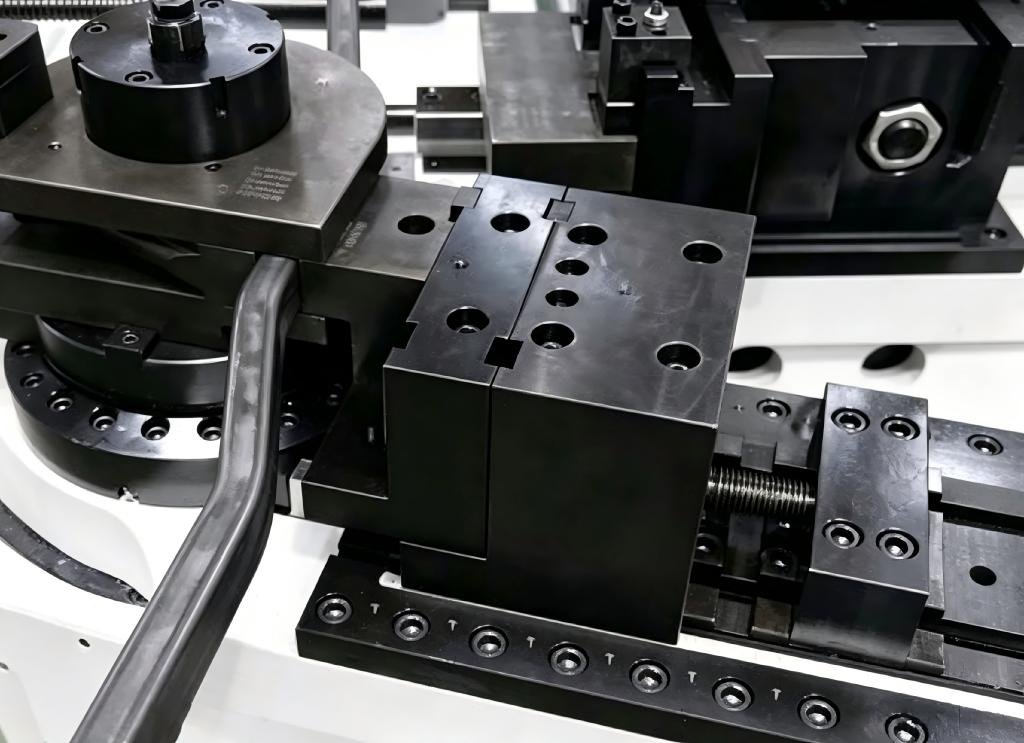
Every tube size and bend radius needs a compatible tool set. The bend die establishes the radius, the clamp die transmits the bending movement and the pressure die supports the tube. A mandrel can control collapse inside the bend, while a wiper die reduces wrinkles on the compressed wall.
Tool geometry must match the tube, but setup is equally important. A mandrel placed too far back may not support the tangent; one placed too far forward can increase drag or marking. An incorrectly set wiper die may fail to control wrinkles or may damage the surface. Pressure and clamping settings should be high enough to prevent slip without creating unnecessary marks.
Tool material and finish should be chosen for stainless steel. Contact surfaces must remain clean because embedded chips can score every part. Lubrication should reduce friction without creating a problem for later welding, cleaning or coating. For practical troubleshooting, read How to Prevent Wrinkles When Bending Stainless Steel and Aluminum Tubes.
Quality Problems and Their Likely Causes
- Inside wrinkles: may result from insufficient support, poor wiper-die position, unsuitable radius, incorrect pressure settings or material variation.
- Excessive ovality: can indicate inadequate mandrel support, a tight radius or incorrect tool fit.
- Outer-wall thinning or cracking: may be related to excessive stretching, unsuitable material condition or an overly demanding radius.
- Angle variation: can be caused by springback changes, tube slip, material variation or unstable machine settings.
- Length or rotation error: may come from manual positioning, feeding errors or an incorrect program.
- Scratches and clamp marks: often point to dirty or worn tooling, excessive force, poor grooves or unsuitable handling.
A good troubleshooting method changes one controlled factor at a time and records the result. If several settings are changed together, it becomes difficult to identify the real cause. Keep an approved first-article sample and setup sheet near the machine for comparison.
Applications Across Major Industries
Automotive and exhaust manufacturers use stainless tubing for exhaust pipes, tailpipes, fluid lines and protective structures that may contain several bends and must fit a limited vehicle envelope. Furniture and bicycle producers need smooth, visible curves for chair frames, table bases, handlebars and racks. Shipbuilding applications include rails, ladders, supports and piping components, while general fabricators produce food-equipment frames, architectural rails, exercise equipment and medical furniture. Each industry emphasizes different combinations of geometry, appearance, corrosion resistance and output.
Calculate Total Cost, Not Only Purchase Price
The true cost includes tooling, installation, training, power, maintenance, labor, scrap, downtime and the effect of inaccurate parts on welding and assembly. Estimate acceptable parts per shift using realistic loading, inspection and changeover time. Compare labor for semi-automatic and fully automatic options, and ask about wear parts, recommended spares and remote support. Confirm which tools are included and the cost of future tool sets.
Acceptance Testing and Documentation
Before ordering, agree on how the machine will be accepted. A useful test uses the buyer’s representative material and one or more challenging parts. Record bend angles, straight lengths, rotations, radius, ovality, visible wrinkles, thinning where critical and surface condition. The finished component should also be tested in its welding or assembly fixture.
Documentation should cover operation, safety, maintenance, basic troubleshooting and machine configuration. Buyers importing equipment should confirm the CE certificate and applicable quality certification documents, electrical requirements, language needs and shipping scope. Operator training should include tooling installation, first-article inspection and safe response to abnormal conditions.
Why Choose Jiuqiang Technology?
Jiuqiang supplies CNC, hydraulic, fully automatic and semi-automatic tube bending equipment. This broad range supports a practical selection based on part complexity, volume and budget. Machines can be evaluated for stainless steel, iron and carbon steel, aluminum, copper, aluminum profiles and other suitable metal tubes.
The company works with customers in automotive, exhaust, furniture, bicycle, shipbuilding and related metal-processing industries. Its experience exporting to Mexico, Spain and Argentina supports international project communication and equipment delivery. The technical process can include drawing review, model selection, bending-sequence analysis, tooling planning and sample evaluation.
Jiuqiang products have CE certification and quality certification documentation. This supports buyer due diligence, factory equipment records and acceptance planning. A customer requiring an automatic system can also review the DW89CNC automatic pipe bending equipment as one example; the final proposal should always be based on the required parts.
Frequently Asked Questions
What is the best machine for thin-wall stainless steel tube?
There is no single model for every thin-wall tube. The machine must provide stable control, but the mandrel, wiper die, bend radius, lubrication and material consistency are equally important. Send the exact tube and drawing for evaluation and request a sample bend for difficult parts.
Can one machine bend different tube materials?
Often yes, provided each part is within the machine’s capacity. Stainless steel, carbon steel, aluminum and copper require different springback compensation, pressure, lubrication and sometimes different tooling. Clean tools carefully to protect surfaces and avoid contamination.
How do I choose between CNC and semi-automatic equipment?
Choose CNC for multi-bend parts, three-dimensional geometry, repeat orders and reduced dependence on manual positioning. Semi-automatic equipment can suit simple shapes, lower volumes and flexible workshops. Compare total cost per acceptable part rather than automation labels alone.
What is the maximum Jiuqiang bending capacity?
The Jiuqiang product range covers metal tubes up to 114 mm outside diameter and wall thicknesses up to 10 mm. Actual capacity depends on stainless grade, radius, cross-section and component geometry, so technical confirmation is required for each project.
How can I get a machine and tooling recommendation?
Use the Jiuqiang contact page to send material data, tube dimensions, part drawings, finish standards and required output. With complete information, the team can recommend a suitable configuration and define the next step for technical review or sample bending.