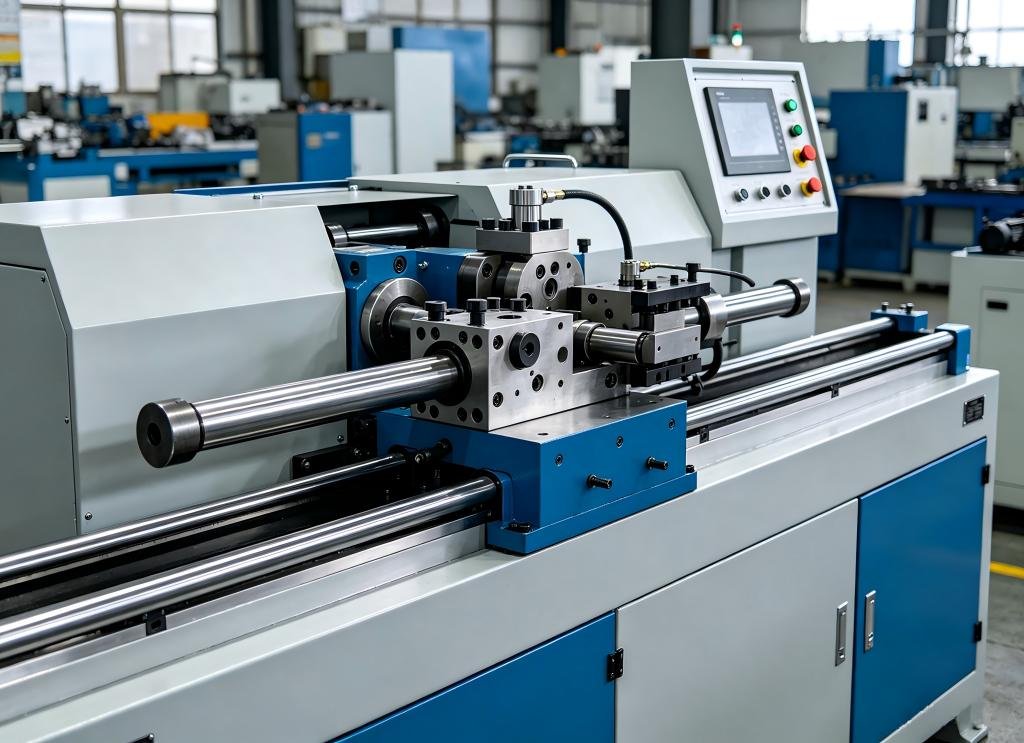
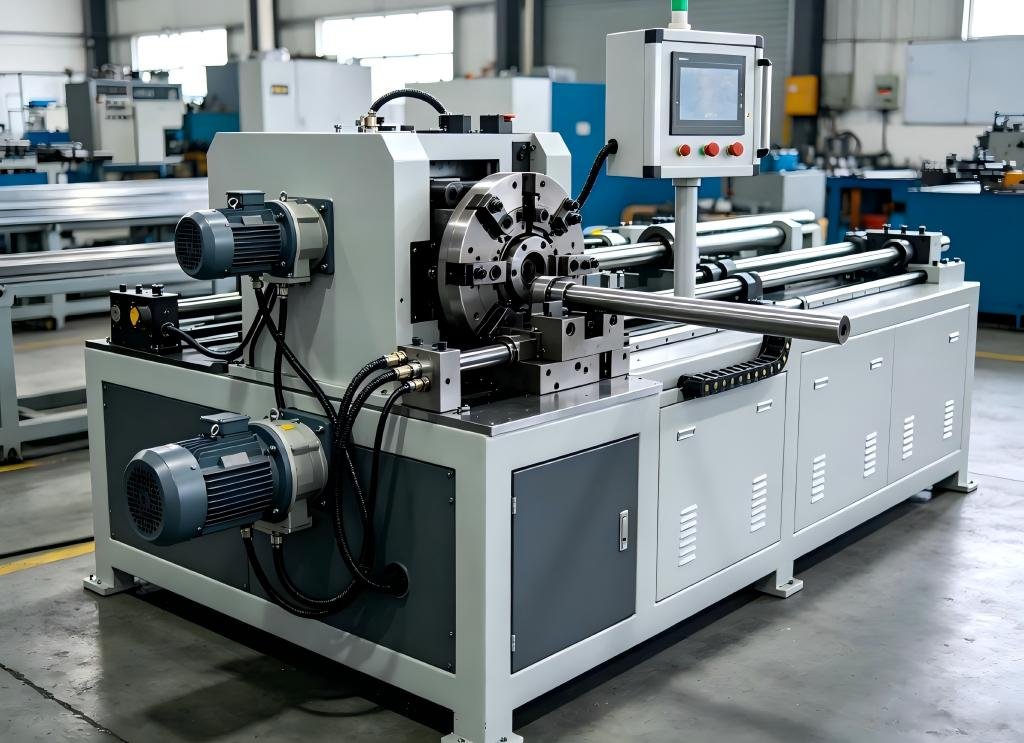
Kids Bicycle Tube Bending Machine: Why the Smallest Frames Pose the Hardest Bending Problem
News 2026-11-17
In the process planning of any bicycle plant, kids’ bikes are usually filed under “simple parts”. The reasoning sounds solid enough: small diameters, thin walls, short bend radii, low tonnage, fast cycle times, so almost any compact bender should manage. Spend one full shift on a kids’ bike line and that impression reverses. Kids’ frames and handlebars are among the tightest-tolerance, most easily hidden-defect, and most demanding parts in the entire bicycle manufacturing chain. A kids’ bike is not a scaled-down adult bike; it is a separate process problem.
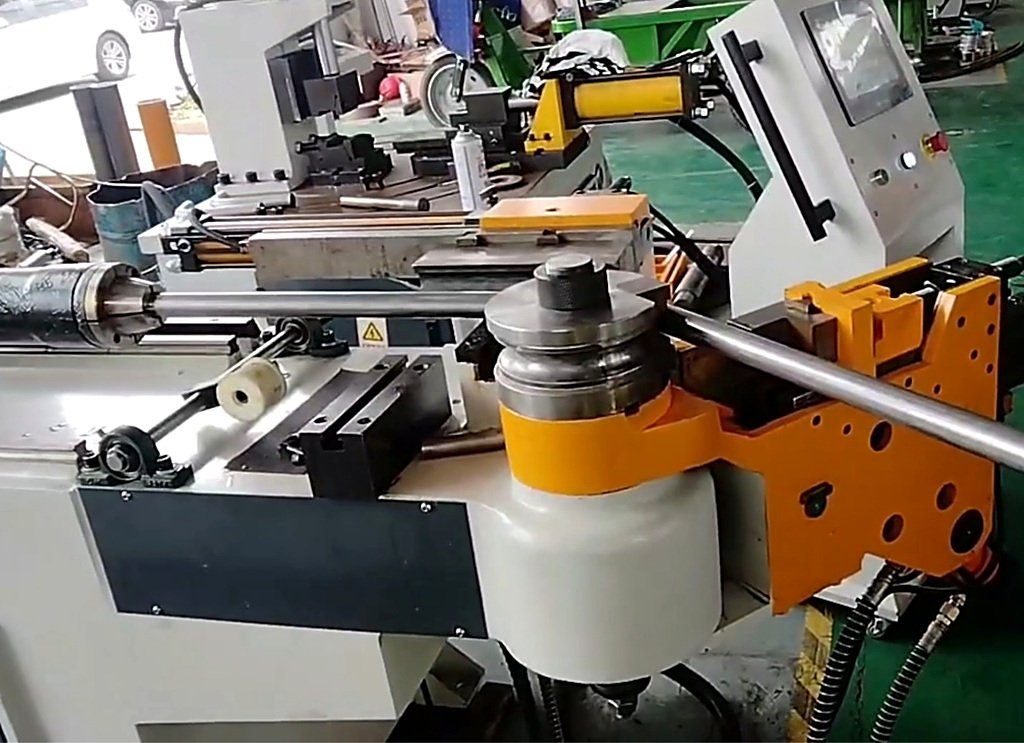
Small Diameter Does Not Mean Low Difficulty, It Relocates It
The tolerance headroom on an adult frame comes from size. A 38 mm outside diameter tube with a 1.6 mm wall bent to 2D leaves enough room for the die, the mandrel and the wiper to constrain the section properly. A kids’ tube of the same wall bent to R30 squeezes mandrel, wiper and clamp die into a working zone only a few tens of millimetres wide, and every positional error in that zone is amplified into a defect you can see.
More importantly, the visibility of defects is completely different. A slight wrinkle on an adult frame may disappear under paint and decals. A kids’ handlebar and front triangle are the first thing a child sees and the first thing a parent touches: thin paint, light colours, small curved surfaces, and every wrinkle, dent, scratch and shading variation is on display. The process window has not widened, the inspection standard has tightened, and that is the real position of kids’ bike tube bending.
Kids’ Frame Geometry Is a Structure Compressed by Scale
Kids’ frames are normally specified by rear wheel diameter and frame height as a pair: 12, 14, 16, 18 and 20 inch wheel sizes each pair with a corresponding frame height to form a family of fixed proportions. The smaller the wheel, the lower the frame height, the narrower the space between head angle and seat angle, the sharper the angles between top tube, down tube and chainstays, and the shorter and denser the bent segments become.
The direct process consequence is compressed straight length. Bending needs a clamping length, needs room for the mandrel to enter and withdraw, and needs enough straight transition between adjacent bends, otherwise the next bend starts forming in a region where the previous bend has not finished releasing stress, and the deformations stack. An 80 mm straight is unremarkable on an adult frame; on a kids’ frame there may be only 25 to 30 mm left. Process design here is no longer a question of whether a bend is possible, but of how the sequence is ordered, where the clamping points land, and whether the dies can physically clear each other.
Tube Selection Sets the Width of the Process Window
Frame tube for kids’ bikes generally falls into three families: high-carbon and low-alloy steel welded tube, stainless steel tube, and 6xxx aluminium tube. Steel forms well, springs back little and is cost-effective, which makes it the mainstay of entry-level production. Stainless offers strength and appearance but work-hardens noticeably, so both springback and surface galling need extra attention. Aluminium saves weight, but its elastic modulus is roughly a third that of steel, springback multiplies accordingly, and thin-wall aluminium is especially prone to wrinkling and thinning at small radii.
Wall thickness is the most underrated variable. General bicycle frame tube walls run roughly from 1.3 mm to 3.5 mm, while kids’ frames typically use 1.2 to 2.0 mm to control weight and cost, with some locations thinner still. A thin wall means a low second moment of area and weak resistance to instability, so wrinkling stops being an occasional defect and becomes a default tendency waiting to happen. Run the same machine and the same tooling with an incoming tube lot whose wall sits at the low end of tolerance and the reject rate can double. This is the classic hidden fluctuation source in kids’ bike bending.
Minimum Bend Radius Is a Material Limit, Not a Design Preference
The lower bound of bend radius is set jointly by the tensile strain limit of the outer wall and the compressive limit of the inner wall. The tighter the radius, the more severe the wall thinning outside, the more material piles up and wrinkles inside, and the more the neutral axis shifts. There is broad industry agreement on an economic band: carbon and stainless tube are comfortable between 1.5D and 3D, while thin-wall aluminium needs to move toward 2D to 3.5D. Below that band the bend is not impossible, but it demands upgrades across mandrel, lubrication, bending speed and tooling, and stability falls.
Kids’ bike design language nonetheless favours small radii: a low step-over top tube hugging the wheel arch, a handlebar with a compact grip span, mudguard and chain guard brackets that must clear in very little space. The most common process error is therefore to open tooling straight from the drawing’s minimum radius and treat the material limit as a negotiable parameter. The correct order is reversed: establish the feasible radius band from material, wall thickness and outside diameter first, then let the structure choose its points inside that band. The radius is given by the material, not by the drawing.
Springback: Angle, Radius and Axis Length Drift Together
Bending is elastoplastic, so unloading always produces springback. Springback is not merely “a few degrees less bend”; it drifts in three directions at once, reducing the bend angle, enlarging the bend radius, and lengthening the tube axis. The three effects add up into parts that look nearly right on a gauge and then fit slightly wrong on assembly.
Small-radius thin-wall parts are the hardest to predict, because springback is sensitive to material lot, actual wall thickness, die clearance and bending speed. Practice usually proceeds in two steps: run a small trial batch to establish springback data for that specific lot, then write the compensation into the program or correct it into the die face; during production, re-verify by lot sampling and recalibrate whenever material changes. Treating springback as a one-time setup adjustment is the most common starting point of a quality incident in kids’ bike bending.
Multi-Radius in One Clamp: What Stacked Dies Really Buy
The handlebar is the clearest illustration. A single bar typically carries three to six bends: grip sections swept up, a straight centre, returns at both ends, and perfect left-right mirroring. Bent one radius at a time on a single-layer die, every radius change means a die change, a re-zeroing and a new datum, and the accumulated error by the fourth or fifth bend becomes uncontrollable, with left-right symmetry left to operator feel.
Stacked-die and multi-layer designs place two or three wheel dies of different radii on the same spindle, and with servo rotation and servo feeding they complete multiple radii in a single clamp. The benefit is not only time saved; it is that the datum is frozen. The tube is never released from beginning to end, every bend references the same original end face, and accumulated error is confined inside one clamping. For short-span, multi-bend, strongly symmetric parts like kids’ handlebars this is a yield-determining process route, not an efficiency option.
Mandrel and Wiper: The Internal Support Logic of Thin-Wall Tube
Under bending, a thin-wall section tends to collapse toward an ellipse and the inner side develops wave-like wrinkling. The core countermeasures are internal support plus external restraint: the mandrel enters the tube to hold the section open, and the wiper die presses against the inner start-of-bend zone to hold the material down.
Mandrel type is chosen against material hardness and radius tightness, from straight, ball, multi-ball, through to universal joint flexible types; the softer the material and the tighter the radius, the more a flexible multi-ball design with greater mandrel extension is needed. Extension itself is double-edged: too little and wrinkling is not suppressed, too much and the mandrel scrapes inside the tube, withdraws with difficulty, and can even score the bore. Kids’ tube diameters are small, so mandrel diameter shrinks with them, stiffness drops, and withdrawal chatter and scoring risk run noticeably higher than in large-diameter work. This is precisely why small-diameter bending places higher demands on machine axis alignment and repeat positioning accuracy.
Weld Seam and Neutral Axis: The Most Overlooked Directional Factor
When welded tube is used for bent parts, seam position directly governs cracking risk. Bending puts the outside in tension and the inside in compression, with the least stress near the neutral axis. Placing the seam where tension peaks means putting a structurally uneven joint in the most dangerous location. Sound practice is to rotate the seam toward the neutral axis, or to fix the seam orientation of the blank at the nesting stage.
Kids’ thin-wall welded tube has a proportionally larger seam, so the issue is sharper. At the same time, kids’ parts are often painted or polished as exposed surfaces, so seam position also affects appearance consistency after finishing: the same seam, bent to the outside, tends to pull open into fine cracks; bent to the inside, it tends to form a visible depression in the wrinkle zone. If the process document and inspection standard do not state seam orientation, the problem will keep surfacing as “occasional cracking”.
Left-Right Symmetry Is a Standalone Specification for Kids’ Parts
Adult left and right parts usually tolerate some deviation because it is hard to notice once assembled. Kids’ bikes are different: narrow bar width, short grip span, and both parent and child feel it directly with their hands. Two degrees of difference between left and right is a crooked grip. An asymmetric rear triangle makes the bike track off-centre and distorts the child’s riding posture.
Symmetry cannot be guaranteed by “running the same program twice”, because in reverse bending the clamping direction, die contact faces and feed datum all become mirrored. The workable approach is to program left and right as two independent routines, run them on the same machine with the same datum fixture, and verify the first piece by overlaying the two halves against each other, judged with instruments rather than eyesight. A frequent oversight is to mirror-copy the left program into the right one while ignoring how the clamp and wiper interference relationship changes after mirroring.
Inspection: Turning “Looks Fine” Into Four Measurable Numbers
In executable terms, kids’ bike tube bending inspection reduces to four numbers: bend angle, bend radius, section ovality, and wall thinning rate. Angle is checked with a template or a coordinate measuring machine, radius with a template or reverse-computed from a 3D scan, ovality as the difference between maximum and minimum diameter in one section of the bend expressed against nominal diameter, and thinning as the drop at the thinnest point of the outer bend relative to original wall.
Tolerances for these four numbers should be graded by part function rather than applied uniformly. Load-critical zones such as the head tube root, bottom bracket area and chainstay start-of-bend deserve tight limits; decorative shallow bends can be relaxed. The first piece must be fully characterised and retained as a reference sample, production is sampled by lot and at material change points, and any change of tooling, material lot or operator triggers a fresh first-piece inspection. Making inspection a process gate rather than a final sorting step is the single most effective cost control in kids’ bike bending.
The Standards Connection: Process Parameters Get Constrained Backwards
Kids’ frames now have a dedicated product standard system covering terminology, product classification, technical requirements and test methods, and it explicitly asks for reinforced design at critical locations such as frame joints and the fork steerer, whether through thicker tube or additional reinforcement structure. Child bicycle safety standards set mandatory indices for structural strength, braking performance and protrusion limits across the preschool to early-grade age range, and newer editions keep refining the test methods.
These standards look one layer removed from the bending operation, yet they constrain process parameters backwards. Reinforcement design means local wall thickness change, and wall thickness change means different springback in different zones of the same tube. Protrusion limits mean that tube-end treatment, threaded hole orientation and bracket positions after bending must be reserved at the forming stage. Strength test loading points frequently land exactly on the transition between bend and straight. If a process document only says “bend to drawing” without translating these constraints into specific mandrel extension, compensation angles and inspection points, the standard stays on paper.
Cycle Time and Changeover: Where the Real Cost of Small Parts Sits
Kids’ bike orders typically arrive as many variants, low volumes, and frequent colour and model changes. One machine may run five or six frame tube part numbers a day at a few dozen to a few hundred pieces each. Cost then does not sit in bending time per piece but in changeover time: die change, datum finding, trial bending, first-piece inspection, compensation adjustment, a sequence that can outlast the production run itself.
There are three levers. Quick-change, pre-set tooling with locating pins, offline pre-assembly and a program library carrying compensation values. One-to-one binding of program and tooling, so calling a program also calls the matching die number and compensation table. And solidifying bending parameters for common sizes into reusable process packages. Get these three right and low volume stops being a synonym for high cost. Conversely, if kids’ bike bending in a plant always depends on a senior operator’s feel at the machine, that plant’s capacity ceiling is actually locked by changeover time.
Conclusion: The Smallest Part Is the Most Honest Exam
The difficulty of kids’ bike tube bending is not in tonnage, stroke or any visible parameter table. It appears when thin wall, small radius, dense bends and strong symmetry all hold at once, the process window is squeezed very narrow, and the question becomes whether machine and process can still sit inside it reliably. That demands repeat positioning accuracy from the machine, sensible mandrel and wiper architecture from the tooling, process documents that turn springback, seam orientation and clamping sequence into executable clauses, and inspection that replaces “looks fine” with four measurable numbers.
A line that gets this operation right is rarely weak on adult frames. A line that treats kids’ bikes as small adult bikes will keep meeting the same problems as occasional defects, later explained away as “that is just how thin-wall parts behave”. Thin-wall parts are not like that. They simply do not tolerate vagueness.