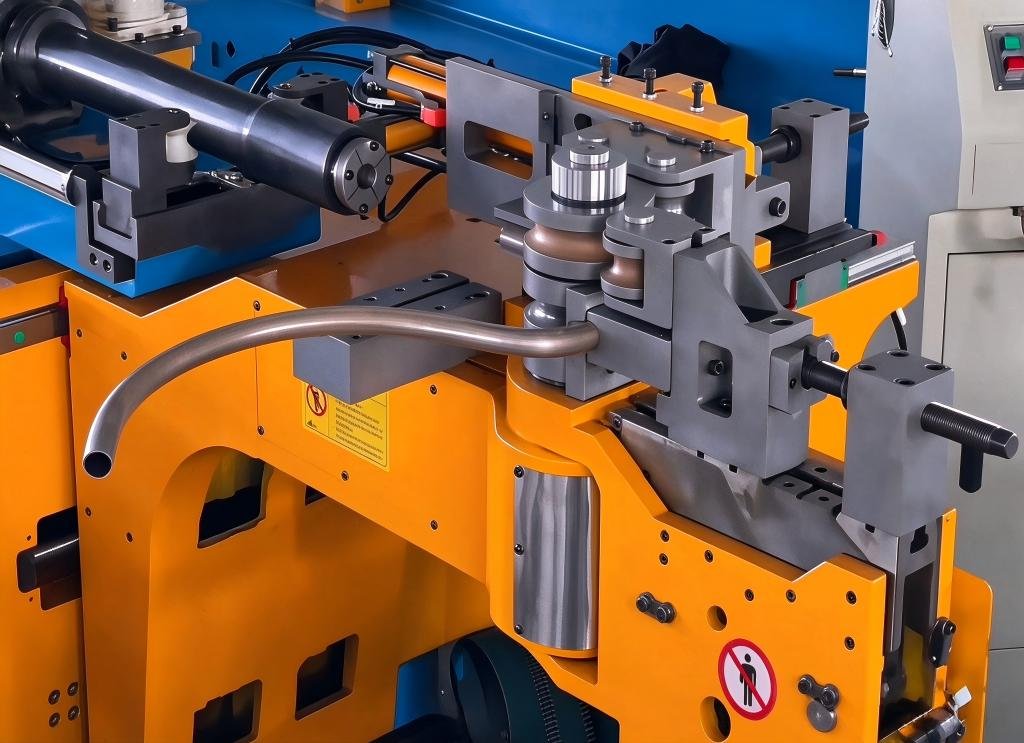
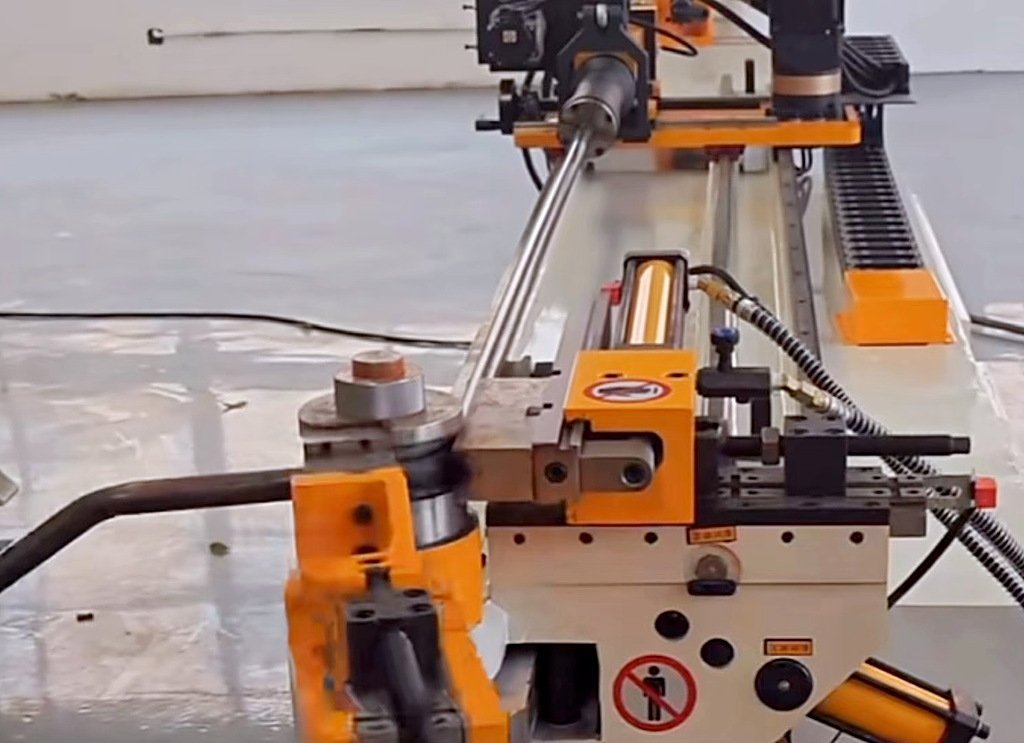
Sports Venue Equipment Tube Bending Machine: Bending Heavy, Thick-Walled Steel Into the Curves Public Sport Depends On
News 2026-11-20
Among the many applications of tube bending, sports venue equipment ranks as one of the most demanding “heavyweight” tests. Air-conditioner copper coils reward thin walls and cleanliness; automotive exhaust systems reward heat resistance and leak tightness. Sports equipment and venue structures face an entirely different set of variables: large tube diameters, heavy wall thicknesses, carbon steel and galvanized tube as the dominant materials, large bending radii often exceeding twice the tube diameter, and one unavoidable fact — nearly every bent component carries human loads. Spectators seated on retractable grandstands, players fighting for a rebound under a basketball hoop, elderly users on outdoor fitness trails: all of them trust their safety to those few curves. In this industry, bending quality is not a cosmetic question. It is the safety baseline.
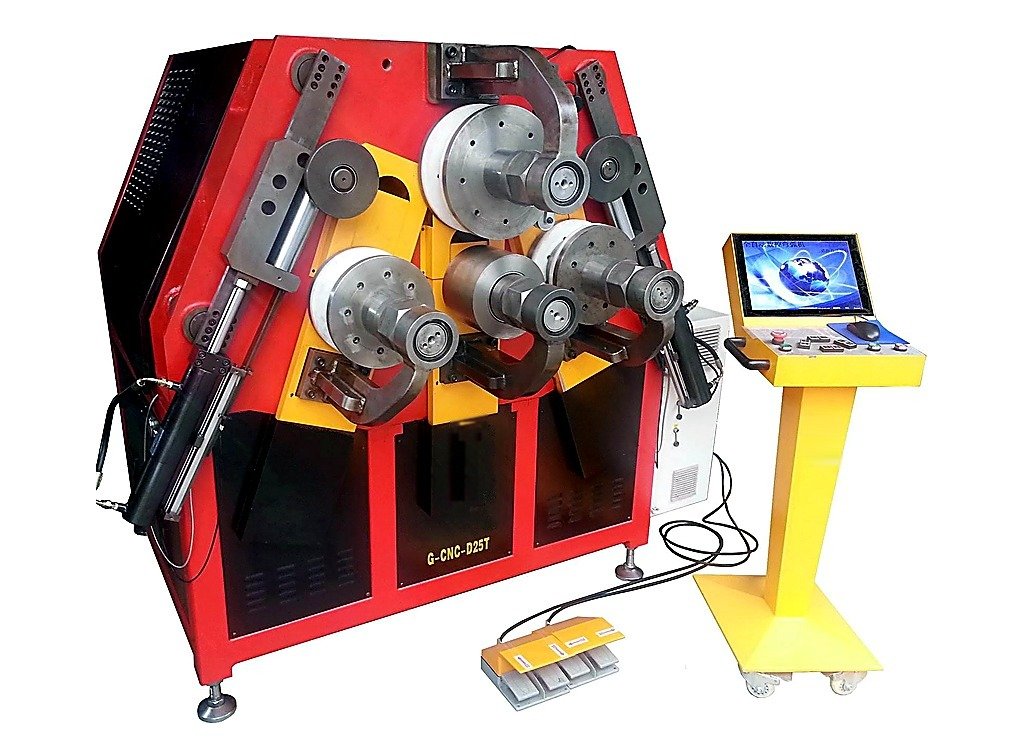
The bending checklist on a single piece of equipment
Take apart an ordinary outdoor basketball hoop and the bending workload quickly becomes obvious. The upright may be a 180 x 180 x 4.5 mm square tube; the extension arms are made from 48 mm diameter tube with a 2 mm wall, formed in a single pass on a tube bending machine; the upper and lower backboard support arms each follow a different arc. The base frame, the protective ring, the steel skeleton behind the padding — every part carries a bend. Then look at the venue itself: curved grandstand framing, arched roof beams, curved facade supports, bent components for canopy structures. These heavy-section profiles define the entire silhouette of the building. One piece of sports equipment or one section of a venue structure often contains a dozen or more bends of different radii and angles, so the efficiency and consistency of the bending operation directly set the rhythm of the whole production line.
Large sections and thick walls: a completely different forming logic
Sports equipment tubes and household appliance tubes live in two different worlds. Air-conditioner copper tube walls are only 0.75 to 1.1 mm thick and rely on mandrels to support the cavity against collapse. Basketball uprights and the main posts of outdoor fitness equipment, by contrast, commonly use galvanized steel tube of 114 mm diameter or larger with a 3.5 mm wall, and square sections of 150 x 150 or 180 x 180 mm are routine. A thick wall gives the section strong intrinsic resistance to distortion, so there is no need for the fine support of a ball-type mandrel — but it also means a much larger bending moment. Bending one thick-wall square section can require more than a hundred times the force needed for copper tube, and the rigidity class of the dies, clamps and spindle changes completely. A tube bending machine built for sports venue equipment is, in essence, a heavy machine: greater torque reserve, thicker shafts, heavier die seats, and die profiles purpose-designed to keep square sections from collapsing.
Bending radius: from the 1.5D limit to the 2D economic range
The industry has a well-known rule of thumb: conventional roll bending can reliably reach a minimum bending radius of about 1.5 times the tube diameter for ordinary carbon steel, while materials with high springback such as stainless steel and copper need radii 15 to 25 percent larger. In the sports equipment industry, however, the radii actually chosen usually sit far above the limit. A common practice in fitness equipment is “76 mm aluminum tube, two-diameter bending radius, multiple bends formed in one setup”, and the pull rods of basketball goals and the handrails of outdoor fitness equipment typically fall in the 2D to 3.5D range. The reason is practical: the larger the radius, the lighter the tensile thinning on the outside of the bend, the lower the wrinkle risk on the inside, and the more stable the section shape. A generous radius also produces the smooth, rounded lines that the visual language of sports equipment demands. A tight radius saves space, but it trades away strength and appearance — and in the sports industry, that trade never balances.
Cold bending, roll bending and stretch bending: a division of labor
Venue projects often mention both “stretch bending” and “roll bending”, and each has its own role alongside conventional rotary-draw cold bending. Stretch bending applies a longitudinal tensile force while the profile is bent, shifting the neutral layer outward and noticeably reducing springback; it delivers high arc-length accuracy and suits curved facade supports where fit-up precision is critical, though it requires profiles with strong bending stiffness and flat faces. Roll bending presses the tube continuously between three rollers and suits large-radius arcs in round, oval and shaped sections — a roof arc beam more than ten meters long is typically formed this way. Conventional rotary-draw bending with dies wins on precision and repeatability: one die locks in one radius, and a hundred parts come out with identical arcs, which makes it the mainstay of mass-produced equipment. The three processes are not substitutes; they divide the work by component type, radius and batch size.
The special character of square tube: collapse and anti-wrinkle control
Sports equipment uses square and rectangular tube extensively, and bending square tube into arcs is one of the hardest jobs in the craft. A round tube tends toward ovality when bent; a square tube distorts in two planes at once — the outside corners spread while the inside corners squeeze inward, and in severe cases the midpoints of both faces cave in, producing a visibly dented surface. The countermeasures live in the tooling: the anti-collapse die profile must constrain the section before it enters the bend zone, and the mandrel — for large square sections, often a multi-ball or purpose-profiled mandrel — must hold exactly the right advance. Advance too far and the inner wall is scored; hold back and the section collapses. The serration design of the clamp is equally critical: thick-wall square sections carry huge bending moments, and even a slip of one millimeter at the clamp shifts the start of the arc and scraps the whole part. This is why equipment buyers in the sports industry look first at clamping force and die rigidity.
Springback: the invisible variable in heavy steel sections
No cold bending escapes springback, and the high-strength carbon steel favored by the sports industry rebounds conspicuously: bend to 90 degrees, release, and the actual angle can fall back by 2 to 5 degrees while the radius opens outward. Modern CNC tube bending machines treat springback compensation as a standard function — after a first trial bend, the measured angle and radius are entered back into the system, and every following part automatically carries the compensation. More advanced setups model both the springback radius and the springback angle directly, predicting correction values from material, wall thickness and the relative bending radius. Three-dimensional bends — several arcs on different planes — additionally require phase-angle compensation, or the second bend will never meet the first in the right direction. For sports equipment, where one product can carry a dozen bends, springback compensation decides whether assembly flows or stalls: an arc off by a single degree and the mounting holes on a goal’s support arm simply will not line up.
Multi-radius forming in one setup: fewer welds, fewer risk points
The sports equipment industry shares an unspoken consensus: the fewer the welds, the safer the structure. Welding is a thermal process; the strength and toughness of the weld and its heat-affected zone can differ from the parent material, and long-term failures tend to start at welds — cracking, then rust. The industry answer is to form pull rods and support arms “in one pass on a bending machine, reducing welding and raising the safety factor”: instead of cutting, welding and straightening a multi-segment structure, a single tube runs through a CNC bender and comes out with several bends of different radii and angles, complete. This demands machines that support rapid die switching between radii — one bend on a 2D radius die, the next on a 3D die, then a rotation and a third bend. Multi-radius forming in one setup saves more than welding hours; it eliminates every weld as a potential failure origin. For outdoor equipment marketed on a ten-year service life, that difference matters.
A mandatory national standard: bending quality sits underneath the safety baseline
Outdoor fitness equipment in China is governed by the mandatory national standard GB 19272, “Safety requirements for outdoor body-building equipment”. From the 2003 edition to the 2011 edition and the 2024 revision, the safety philosophy has evolved from single-machine mechanical safety to whole-lifecycle risk management. The standard sets hard requirements for gaps, protrusions, loading and stability — and every one of those indicators rests on bending quality underneath: a handrail arc that protrudes too far can snag clothing, a collapsed bend weakens the section that must carry load, and inaccurate springback compensation produces assembly gaps that fail inspection. A common specification for main posts calls for standard galvanized tube of no less than 114 mm diameter with a 3.5 mm wall — the wall thickness comes from the design, but whether every bend preserves that thickness intact is decided by the bending process. Put plainly: GB 19272 inspects the finished product, while the tube bending machine decides whether the product can pass.
Galvanizing and coating: how bending order shapes corrosion life
The anti-corrosion coating is the other pillar of outdoor equipment longevity, and it hides a process-order question that is easy to overlook: bend first and then galvanize, or galvanize first and then bend? Hot-dip zinc coatings are thick and hard, and cold bending after galvanizing cracks and flakes the zinc — the bend zone becomes the starting point of rust. Heavy structural members therefore generally follow a “bend first, coat second” sequence: bending works bare tube, and pickling, phosphating, hot-dip galvanizing or electrostatic powder coating come after forming. That places the bending operation at the very top of the corrosion chain. Surface defects from bending — scratches, pressure marks, wrinkles — are faithfully magnified by the coating: pits inside wrinkles never take zinc and surface later as rust spots. For the bender itself, this raises the bar once more on die surface quality and lubrication: smooth dies and a steady bending speed keep the bare arc clean, so the coating that follows has a fair foundation.
From one-off to batch: servo CNC resets the production rhythm
Sports equipment orders have a distinctive shape: venue projects arrive in large batches on tight deadlines, while national fitness programs scatter huge volumes of small-format equipment across thousands of sites. With conventional hydraulic benders, every die change and re-test of compensation could consume half a day, leaving small orders barely profitable. Servo CNC bending changes the equation: all axes — feeding, rotation, bending and auxiliary — run under closed-loop control, programs and compensation values are recalled from the library, and changeover time drops from hours to minutes. Automatic feeding and end positioning let one operator tend the bender while the next operation assembles. For large venue projects, several machines working in step with three-dimensional bend programs deliver curved components on a daily beat; for distributed fitness-trail orders, the flexibility to change over today and ship tomorrow becomes part of the ability to take orders at all.
Bending inspection: three gates in the sports equipment industry
Before a piece of sports equipment ships, its bent sections pass three gates. The first is geometry: arc radii are compared against gauges or a coordinate measuring machine, angle tolerances are typically held within plus or minus one degree, and critical pull-rod components also face flatness checks. The second is the section: ovality and square-tube collapse must stay inside standard limits, wall thinning in the bend must not exceed the allowed rate, and no visible wrinkles may appear on the inside of the arc. The third is structure: after assembly, static load and stability tests run to the standard — basketball goals face dunk-impact simulation, and fitness equipment is loaded to multiples of the maximum user weight. Any failure at any gate traces back to a bending parameter — die wear, lost compensation, clamp slippage. Causes live upstream, consequences downstream: that is the sports industry’s plainest and strictest expectation of tube bending.
Conclusion: public safety, bent into every arc
Every curve in a sports venue — the grandstand’s sweep, the canopy’s arc beam, the pull rod of a basketball goal, the handrail loop on a fitness trail — is formed inch by inch by a tube bending machine, with dies, force and precision. This industry never asked for the glossy surfaces of consumer electronics, but it carries a weight of responsibility few sectors match: once the equipment stands, it faces an undifferentiated public and an outdoor environment measured in decades. The value of a tube bending machine for sports venue equipment lies in collapsing these difficulties — large sections, thick walls, multiple radii, three-dimensional bends — into one repeatable process window, so that every arc is good to look at, strong to lean on, and still rust-free after ten years. When the curves are bent right, safety truly lands.