Automatic Bending Machine: How Servo-Driven CNC Tube Forming Is Reshaping High-Volume Metal Fabrication
News 2026-11-05
Against the broader backdrop of manufacturing upgrading, tube bending — a fundamental operation in the metal fabrication chain — is undergoing a decisive shift in both drive technology and control logic. Since the start of 2026, rising precision and consistency requirements from new-energy vehicles, HVAC and refrigeration, high-end equipment, and smart furniture have turned the automatic bending machine from an optional investment into standard equipment on volume production lines. Industry observation suggests the core of this transition is not simply “automation,” but a combined breakthrough in servo drives, closed-loop control, rapid tool-change systems, and end-to-end digital management.
From Hydraulic to Servo-Electric: A Generational Change in Drive Systems
Traditional hydraulic bending machines, valued for their high torque output, have long dominated large-diameter and thick-wall tube processing. Their inherent weaknesses, however, have become increasingly difficult to reconcile with precision manufacturing: elevated energy consumption, accuracy that depends on operator experience, and the contamination and maintenance burden caused by hydraulic oil leakage.
In recent years, servo-electric bending machines have emerged as the mainstream upgrade path. Because servo motors deliver power on demand, overall energy consumption can drop by 30 to 50 percent compared with hydraulic systems, while the removal of hydraulic valves and piping — the most failure-prone components — extends mean time between failures and cuts maintenance costs substantially.
The precision gains are even more significant. With closed-loop servo control and encoder feedback, bending angle accuracy typically reaches ±0.1°, and feed-length accuracy can be held within ±0.05 mm, with some high-end configurations performing even better. For exhaust lines, aerospace ducting, and medical device frames — tube components exquisitely sensitive to forming consistency — this level of accuracy translates into a fundamental improvement in batch yield.
Closed-Loop Control and Springback Compensation: Encoding Craft Experience into Programs
The single greatest process challenge in tube bending is springback. Depending on material, wall thickness, and bending radius, every tube relaxes differently after unloading, and traditional production relied on repeated trial cuts by experienced operators. Modern automatic bending machines solve this with built-in springback compensation algorithms. Combined with laser measurement and online angle detection, the machine corrects the bending angle in real time during forming, converting an experience-dependent adjustment process into programmatic data control.
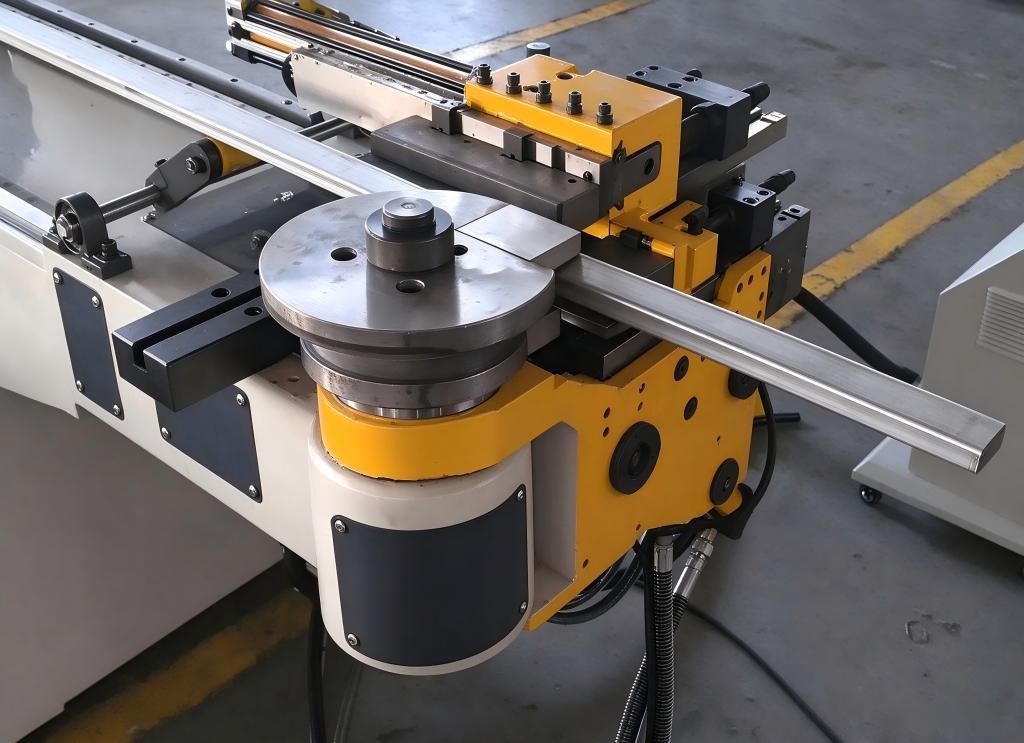
Multi-axis coordinated programming amplifies the advantage further. With a single setup, an operator can complete multiple bending operations on complex three-dimensional parts: the machine automatically coordinates feed, rotation, and bending motions, reducing interference and wrinkling. Round, square, and profile tubes alike can be bent in three-dimensional space under one unified control system. Some models now incorporate machine learning that optimizes parameter combinations from historical processing data, showing particularly strong adaptability on difficult materials such as titanium and stainless steel.
Multi-Stack Tooling and Flexible Volume Production: The Key to Multi-Product Orders
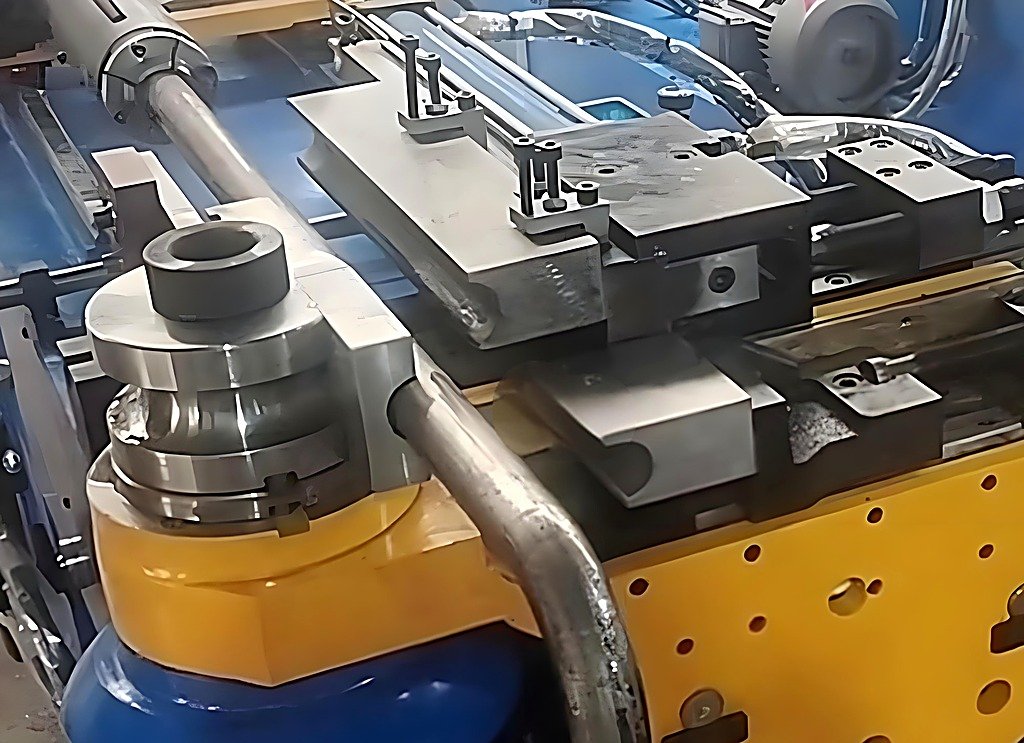
Multi-product, small-batch orders have become the norm in tube fabrication. On conventional single-die machines, tool change and re-debugging can take fifteen to thirty minutes — a major bottleneck for flexible production. The new generation of automatic bending machines addresses this with multi-stack tooling: multiple die sets of different specifications and radii are pre-mounted, and the CNC system switches positions automatically in seconds, enabling “one clamping, continuous bending.”
Combined with program storage for hundreds of process recipes, the machine can recall the right parameters when switching jobs, dramatically shortening changeover time. Add fully automatic feeding, positioning, bending, and unloading, and some lines deliver several times the output of conventional equipment with 18-to-24-hour continuous operation capability — equipment-level assurance for tight project schedules.
From Stand-Alone Machines to Workstations: Full-Process Automation and Data Connectivity
Competition in this sector has shifted from single-machine performance to complete solutions. A typical automatic bending workstation integrates automatic loading, precision cutting, intelligent bending, online inspection, and automatic unloading, with industrial robots handling part transfer to achieve lightly-manned — or even unmanned — production from raw material to finished component, at a markedly higher production tempo.
Intelligent management is spreading just as quickly. AI vision systems automatically detect surface defects such as scratches and dents, rejecting nonconforming parts at the source. Remote-maintenance platforms support self-diagnosis and tooling-life warnings, reducing unplanned downtime. Machines can also connect to MES and ERP systems, uploading operating data, production progress, and quality parameters in real time — with every tube’s processing record stored and traceable to meet the documentation requirements of high-end industries.
A Continuously Expanding Application Landscape
Automotive remains the largest downstream market: exhaust lines, brake lines, seat frames, and liquid-cooling circuits for EV battery packs drive most demand. In furniture, scratch-free bending of decorative stainless tubes for chair arms and metal bed frames sets a high surface-quality bar. HVAC and refrigeration, fitness equipment, juvenile products, aircraft seating, and marine piping all continue to pull demand for multi-specification, high-precision bending equipment.
Selection Guidance and Outlook
Manufacturers planning a line upgrade should first define their processing envelope: tube material and diameter range, wall thickness, minimum bending radius, and target cycle time. Close attention should then be paid to the number of servo axes and the type of closed-loop feedback, the tool-change mechanism, springback compensation capability, and the openness of data interfaces. After-sales response speed and spare-parts availability remain essential to long-term stable operation.
Looking ahead, as demand from new-energy vehicles, energy storage, and high-end equipment continues to expand, automatic bending machines will keep evolving toward higher precision, faster changeovers, and deeper connectivity. The fabricators who convert servo-driven CNC forming capability into dependable volume delivery first will hold the advantage in this round of tube-processing competition.