Chair Stainless Steel Tube Bending Machine: A Complete Guide for Furniture Frame Production
News 2026-09-08
A chair stainless steel tube bending machine is a core production tool for manufacturers of dining chairs, office seating, hotel furniture, outdoor chairs, bar stools, waiting-room seats and other tubular furniture. The machine must create accurate curves without wrinkles, excessive flattening or visible tooling marks. It must also keep left and right components consistent so that welding fixtures, upholstery and final assembly fit correctly.
This guide covers machine types, bending tooling, process planning, surface protection, quality inspection and purchasing decisions for stainless steel chair frames. It also explains how Jiuqiang CNC, hydraulic, fully automatic and semi-automatic solutions can support furniture factories with different products and production volumes.
Why Stainless Steel Is Popular for Chair Frames
Stainless steel offers a combination of strength, corrosion resistance and a clean decorative finish. It is widely used in furniture for restaurants, hotels, offices, hospitals, public buildings and outdoor spaces. Depending on the design, a chair may use round, square, rectangular or oval tubing for legs, backrests, armrests, seat supports and connecting frames.
A brushed, polished or plated metal frame is highly visible. Customers therefore judge not only whether the chair is structurally sound but also whether the bends are smooth and symmetrical. Deep clamp marks, scratches, wrinkles and inconsistent radii can cause rejection even if the tube is still functional. Accurate bending also improves weld-joint alignment and reduces the time needed to force parts into a fixture.
Stainless steel introduces process challenges. It can spring back more than mild steel, and thin-wall furniture tubing can lose its cross-sectional shape during a tight bend. Rectangular and oval tubes require especially careful orientation and tooling support. These factors make machine selection and tool design central to both product quality and production cost.
Chair Components Produced by Tube Bending
Furniture manufacturers use tube benders for many different parts. Common examples include continuous sled bases, U-shaped legs, backrest frames, armrests, under-seat supports, foot rings for bar stools, linking frames for waiting chairs and decorative side structures. Some parts require only one plane and two bends. Others contain several bends and rotations that create a complete three-dimensional frame.
The best machine for a simple U-shaped support may not be the best machine for a complex office-chair armrest. A purchasing decision should begin with a representative group of parts: the largest tube, the smallest radius, the thinnest wall, the greatest number of bends and the most demanding surface finish. Reviewing only an easy sample can lead to a machine that cannot produce the full product range.
CNC, Hydraulic, Automatic or Semi-Automatic?
CNC tube bending machines
A CNC machine controls feeding, rotation and bending with a stored program. It is well suited to chair parts with multiple bends, repeat orders or strict left-right symmetry. Programs for different furniture models can be saved and recalled, reducing manual calculation and helping experienced operators transfer a qualified process to later production batches.
Hydraulic and semi-automatic machines
A hydraulic or semi-automatic chair tube bending machine can be practical for simple parts, smaller batches and factories where the operator manually positions the tube between cycles. The investment may be lower, and the equipment can be flexible for frequent product changes. The tradeoff is greater dependence on operator positioning, measurement and handling.
Fully automatic systems
Fully automatic equipment is intended for stable, higher-volume production where automatic feeding, rotation and bending reduce manual work. Loading and unloading options can be evaluated when the output and part design justify them. Automation should be selected using a realistic calculation of cycle time, labor, scrap, changeovers and annual volume.
Jiuqiang offers all four configuration types. This allows the equipment proposal to be matched to the chair component rather than using automation as a one-size-fits-all answer.
Tooling Determines the Quality of the Bend
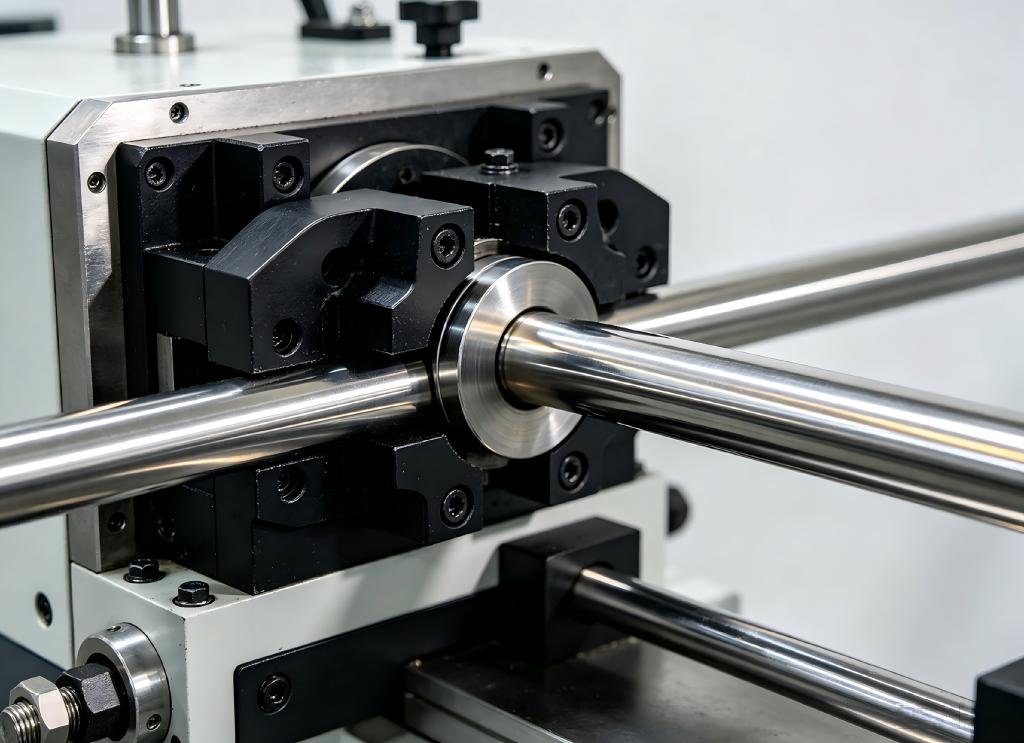
The bending machine provides controlled motion and force, but the tool set directly supports the tube. A typical rotary-draw system may include a bend die, clamp die, pressure die, mandrel and wiper die. Each item must match the tube size and desired centerline radius.
- Bend die: establishes the bend radius and guides the tube around the curve.
- Clamp die: grips the tube securely so it does not slip during bending.
- Pressure die: supports the straight section as it moves through the bend.
- Mandrel: supports the inside of the tube to limit collapse and ovality.
- Wiper die: controls compression near the tangent and helps prevent inside wrinkles.
Thin-wall stainless steel, tight radii and high appearance standards make tooling more important. Tool surfaces should be smooth, correctly aligned and free from chips. Worn or dirty tools can mark a polished chair frame. Lubrication must be compatible with the material and later processes such as welding, polishing, coating or cleaning.
Controlling Common Chair Tube Defects
Wrinkles on the inside radius
Wrinkles usually indicate that the compressed wall is not being controlled. Causes can include an unsuitable radius, incorrect wiper-die position, insufficient mandrel support, pressure-die settings or material variation. Correcting the cause is better than hiding the defect during polishing. Jiuqiang’s article about preventing wrinkles in stainless steel tube bending explains these relationships in more detail.
Ovality and flattening
The tube cross-section naturally tends to distort during bending. Excessive flattening can reduce appearance, interfere with plugs or fittings and weaken the component. A mandrel, proper pressure-die support and a less aggressive radius can improve the result. For rectangular or oval tubes, tooling must also prevent twisting and preserve the intended face orientation.
Springback and inconsistent angles
After the bend is released, stainless steel recovers elastically. The program can compensate by bending beyond the final target, but the correct compensation should be established through measured trial parts. Changes in material grade, wall thickness or tube batch can change the result, so incoming-material control remains important.
Scratches, clamp marks and dents
Visible furniture requires careful contact surfaces and consistent clamping. Too little clamping may allow the tube to slip; excessive or badly distributed clamping can leave marks. Tool polishing, proper grooves, clean handling and suitable lubrication reduce cosmetic defects. Finished tubes should be stored in racks that prevent metal-to-metal damage between operations.
Building a Reliable Chair Frame Production Process
- Define the specification. Record tube material, size, wall, radius, angle, finish, dimensional tolerance and required output.
- Cut and deburr accurately. Tube-length variation becomes leg-length or frame-position variation after bending.
- Control weld-seam orientation. For welded tube, use a consistent seam position when the process or appearance requires it.
- Set and inspect the tooling. Confirm alignment, mandrel location, wiper-die position and clean contact surfaces.
- Produce a measured first article. Check angles, lengths, radii, rotations, ovality and appearance.
- Test the part in the welding fixture. A bend should be approved based on final assembly fit, not only individual dimensions.
- Save the program and setup record. Record tooling, compensation, lubrication and material batch.
- Monitor production. Inspect at planned intervals to detect tool wear or material changes before a large batch is affected.
Improving Productivity Without Sacrificing Finish
Productivity is more than the fastest bending movement. Manufacturers should measure acceptable parts per shift, including loading, inspection, changeover, rework and downstream welding fit. Stored CNC programs, clearly identified tools and first-article setup records make repeat orders more predictable. Automatic feeding is valuable for long, multi-bend parts, while quick setup may be more important for a factory with many short runs.
How to Specify a Chair Tube Bending Machine
Send the supplier complete information for several representative parts. Include 2D or 3D drawings, tube cross-section, outside dimensions, wall thickness, material grade, centerline radius, bend angles, straight lengths and required rotations. State the maximum tube length, expected pieces per shift and whether the surface will be brushed, polished, plated, painted or hidden.
Also identify operations before and after bending. Pre-punched holes can deform if they are too close to the bend. Welded brackets may interfere with tooling. Polishing allowance, end forming and welding fixtures can affect cut length and bend sequence. Early review reduces expensive tooling or process changes later.
A sample-bending test should use material that represents normal production. The test criteria should be agreed in advance: geometry, ovality, wrinkle level, surface marks and fixture fit. Photos alone are helpful but do not replace measured inspection.
Jiuqiang Advantages for Furniture Manufacturers
Jiuqiang Technology manufactures metal pipe and tube bending equipment for furniture, automotive, exhaust, shipbuilding and other industries. The available range includes CNC, hydraulic, fully automatic and semi-automatic machines for stainless steel, iron and carbon steel, aluminum, copper, aluminum profiles and other suitable metal tubing.
Models within the Jiuqiang range can cover tubes up to 114 mm in outside diameter and wall thicknesses up to 10 mm, depending on material strength, bend radius and part design. For chair and furniture work, the technical team can review tube drawings, recommend the appropriate automation level and plan tooling for round or shaped tubes. Manufacturers can view the DW-219NC chair and furniture pipe bending machine as one example from the product range.
Jiuqiang products include CE certification and quality certification documentation. These records help buyers evaluate machine conformity and organize internal equipment acceptance. Jiuqiang also has export experience in Mexico, Spain and Argentina, supporting overseas customers with project communication, machine selection, tooling coordination, operating information and after-sales assistance.
Buyer’s Checklist
- Confirm the most difficult tube size, wall and bend radius.
- Review both round tubes and any square, rectangular or oval profiles.
- Define acceptable wrinkles, ovality and surface marks.
- Calculate production using good parts per shift, not theoretical machine speed.
- List included tools, optional tools and future tool costs.
- Agree on a sample-bending and acceptance procedure.
- Review operator training, maintenance, spare parts and remote support.
- Confirm the CE certificate and quality documents supplied with the equipment.
Frequently Asked Questions
Can the same machine produce dining chairs and office-chair components?
Yes, if every part falls within the machine’s capacity and physical working envelope. Each tube size and radius normally requires suitable tooling, and complex three-dimensional components may require CNC feeding and rotation. Review the complete product family before selecting the model.
Can a chair tube bender process square or oval stainless steel tubing?
Many projects can be evaluated for shaped tubing, but the tooling must match the exact cross-section and corner radii. The process must prevent twisting, face distortion and cosmetic marks. A drawing and sample are important for confirming feasibility.
When is a mandrel needed for chair frames?
A mandrel is commonly considered for thin walls, tight radii or strict ovality requirements. A generous-radius, thicker-wall part may not need one. Sample bending is the best way to confirm the tooling plan.
How do I reduce differences between left and right chair frames?
Use controlled cut lengths, qualified CNC programs where appropriate, consistent material, calibrated bending settings and an assembly checking fixture. Store and identify programs clearly so the correct mirrored sequence is used.
How can I request a Jiuqiang machine proposal?
Send drawings, tube specifications, finish requirements and production targets through the Jiuqiang contact page. Including the hardest part and a representative tube sample will help the technical team prepare a more accurate machine and tooling recommendation.