Bicycle Stainless Steel Tube Bending Machine: Precision CNC Bending for Frames, Handlebars and Racks
News 2026-09-08
A bicycle stainless steel tube bending machine must do more than form a tube to the correct angle. It must also protect the surface, control springback, limit ovality and keep every part consistent enough for accurate welding and assembly. These requirements are especially important for premium bicycle frames, handlebars, luggage racks, cargo-bike structures, e-bike protection tubes and other visible components made from stainless steel.
This guide explains the bending process, machine configurations, tooling, quality checks and purchasing factors that bicycle component manufacturers should consider. It also introduces Jiuqiang solutions for companies that need CNC, hydraulic, fully automatic or semi-automatic tube bending equipment.
Why Bicycle Manufacturers Use Stainless Steel Tubes
Stainless steel is selected for bicycle components because it combines mechanical strength, corrosion resistance and an attractive surface. Unlike painted carbon steel, a brushed or polished stainless steel part can retain its appearance without a thick protective coating. This makes the material suitable for premium bicycles, city bikes, cargo bikes, public-bike fleets and accessories that are frequently exposed to rain or road contamination.
Common stainless steel bicycle parts include handlebars, frame members, seat supports, chain stays, luggage racks, baskets, kickstand components, fenders, guards and structural tubes for electric or cargo bicycles. The exact grade, tube diameter and wall thickness depend on the component design and the applicable strength and weight requirements.
However, stainless steel can be more demanding to bend than mild steel. It tends to spring back after the bending force is removed, and thin-wall tubes may wrinkle on the inside of the bend or flatten on the outside. A polished surface can also be scratched by unsuitable tooling or contamination. A well-configured bending machine and a process matched to the tube specification are therefore essential.
What a Bicycle Stainless Steel Tube Bending Machine Does
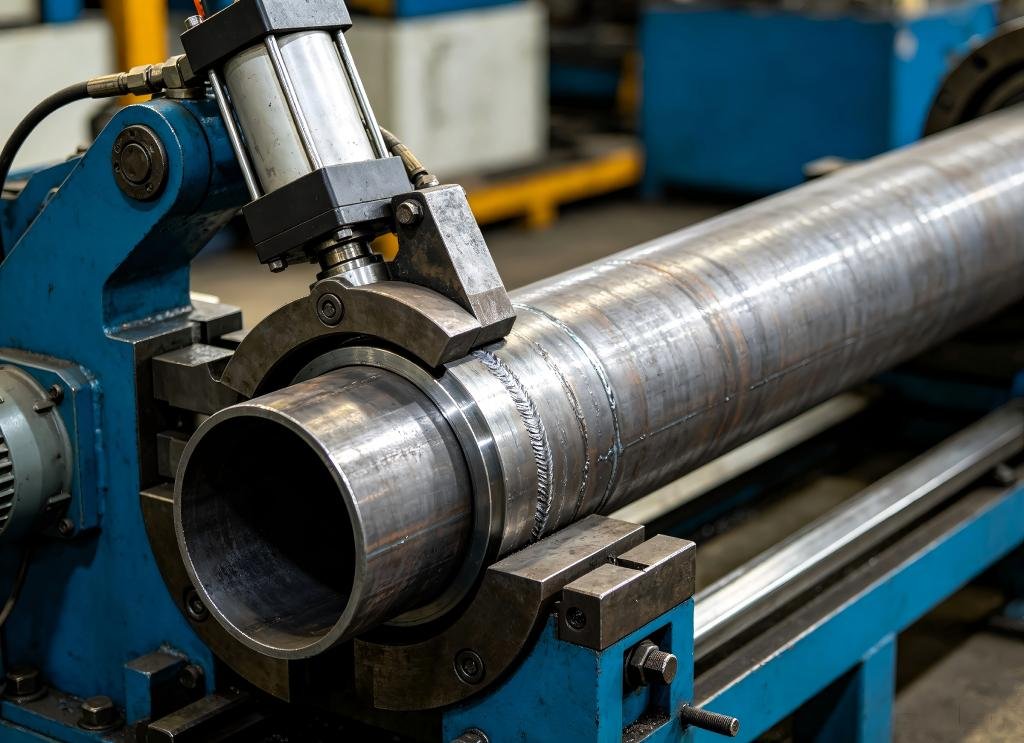
For most bicycle tubes and accessories, rotary-draw bending is the preferred process. The tube is clamped to a bend die and drawn around a controlled radius. A pressure die supports the straight section, while an internal mandrel and an external wiper die may be added when the wall is thin, the radius is tight or the required appearance is particularly demanding.
A CNC tube bender can coordinate feeding, rotation and bending through a stored program. This is useful for three-dimensional parts that contain several bends in different planes, such as handlebars, rear carriers and cargo-bike frames. Once a qualified program is saved, the operator can reproduce the sequence with less manual measurement and lower risk of orientation errors.
Hydraulic and semi-automatic machines can be practical for simpler parts, lower production volumes or components with only one or two bends. Fully automatic CNC systems are better suited to repeat orders, multiple-bend parts and production cells where consistent output and reduced handling are priorities. The correct choice depends on the product family, daily quantity, changeover frequency and available labor—not simply on the highest automation level.
Critical Bending Challenges for Bicycle Stainless Steel
Springback and angle accuracy
Stainless steel elastically recovers after bending, so the final angle can be more open than the commanded angle. The amount of springback changes with material grade, heat, wall thickness, bend radius and tube condition. A qualified program normally includes compensation established through trial bending. For stable mass production, the material specification and incoming tube quality should also be controlled.
Wrinkles, flattening and wall thinning
The inside wall is compressed during bending, while the outside wall is stretched. If support is insufficient, compression can create wrinkles and stretching can cause excessive thinning or ovality. The risk increases as the centerline radius becomes tighter and the tube wall becomes thinner. Correct mandrel position, wiper-die setting, pressure-die force and lubrication help maintain the cross-section. For more detail, see Jiuqiang’s guide to preventing wrinkles in stainless steel and aluminum tube bending.
Surface scratches and tooling marks
Bicycle parts are often visible to the final customer. Small scratches that would be acceptable on a hidden industrial tube may be rejected on a polished handlebar or carrier. Tooling contact surfaces should be clean and smooth, and chips or carbon-steel contamination must be removed. Tool material, surface treatment and lubrication should be selected for the required finish. Protective film may be useful in some processes, but it must be evaluated because it changes the effective tube size and friction.
Three-dimensional orientation
A multi-bend bicycle component may meet every individual angle specification and still fail assembly if the rotation between bends is wrong. CNC feeding and rotation reduce this risk by controlling the distance and plane of each bend. A checking fixture or coordinate measurement method should verify the finished geometry before a program is released for production.
Machine Features That Matter in Bicycle Production
- Programmable feeding, rotation and bending: important for handlebars, carriers and other multi-bend components.
- Program storage: allows qualified bicycle models to be recalled for repeat orders and faster changeovers.
- Mandrel and wiper-die compatibility: provides additional support for thin walls and tight radii.
- Stable clamping and pressure control: reduces tube slip and inconsistent angles.
- Suitable tooling surfaces: helps protect brushed, polished or decorative stainless steel.
- Accessible setup and maintenance: reduces downtime when products or tooling change.
- Safety system and documentation: important for international installation, operator training and regulatory review.
How to Select the Right Configuration
Begin with the actual parts, not a general machine label. Prepare the tube outside diameter, wall thickness, stainless steel grade, cut length, centerline radius, bend angles, distance between bends and three-dimensional drawing. Also state whether the tube is seamless or welded and identify the surface requirement. The supplier needs this information to evaluate tooling, machine capacity and possible interference between the part and machine.
For prototypes, spare parts and low-volume accessories, a hydraulic or semi-automatic tube bender may provide an economical solution. For repeated production of multi-bend parts, a CNC machine with automatic feeding and rotation can reduce operator dependence. A fully automatic system may add loading, unloading or integration options when production volume justifies them.
Machine capacity must include more than nominal outside diameter. Stainless steel strength, wall thickness, radius and required tooling all affect the required bending force and clamping force. A supplier should evaluate the complete part drawing before confirming a model.
A Practical Bicycle Tube Production Workflow
- Confirm the drawing and tube specification. Define critical dimensions, allowable ovality, surface standard and inspection method.
- Prepare the tube. Cut to length, deburr both ends and remove chips that could damage tooling or the internal mandrel.
- Install and align the tooling. Check the bend die, clamp die, pressure die, mandrel and wiper die for correct position and cleanliness.
- Run a first-article bend. Measure angle, rotation, leg length, radius, ovality and surface condition.
- Compensate for springback. Adjust the program using measured results rather than guesswork.
- Approve the part in an assembly fixture. This confirms that the bent tube will fit welding and downstream operations.
- Lock the qualified program and record setup data. Preserve tooling positions, lubrication and material information for repeatability.
Quality Checks for Bent Bicycle Tubes
A complete inspection plan should cover geometry and appearance. Check the final bend angles, straight lengths, rotations between bends and overall part envelope. Measure ovality and inspect the inner radius for wrinkles, the outer radius for excessive thinning and the complete surface for scratches or clamp marks. When the component will be welded into a frame or rack, verify it in the intended fixture because small dimensional errors can accumulate across several parts.
Traceability also matters. Recording the tube batch, machine program, tooling set and first-article result makes it easier to investigate changes. Preventive maintenance should include lubrication, hydraulic condition where applicable, clamping components, mandrel wear and tooling cleanliness.
Jiuqiang Advantages for Bicycle Tube Manufacturers
Jiuqiang Technology supplies pipe and tube bending machines for a wide range of metal-processing applications. Available solutions include CNC, hydraulic, fully automatic and semi-automatic configurations, allowing a manufacturer to select equipment according to part complexity and output instead of forcing every project into one machine type.
Jiuqiang’s product range can cover metal tubes up to 114 mm in outside diameter and wall thicknesses up to 10 mm, subject to the material, radius and detailed part evaluation. That broad capacity is useful for manufacturers producing not only bicycle tubes but also related furniture, automotive, exhaust and structural components. Machines can be configured for stainless steel, iron and carbon steel, aluminum, copper, aluminum profiles and other suitable metal tubes.
For bicycle projects, Jiuqiang can evaluate part drawings, bending sequences and tooling requirements before machine selection. A sample or trial-bending discussion helps confirm whether a mandrel, wiper die or special surface-protection measure is required. Customers can also review a relevant automatic model such as the DW75CNC stainless steel tube bending machine.
Jiuqiang products are supplied with CE certification and quality certification documentation, supporting equipment acceptance and international purchasing requirements. The company has export experience serving customers in Mexico, Spain and Argentina and can support machine selection, tooling coordination, operating documentation and after-sales communication for overseas projects.
Questions to Ask Before Ordering
- Has the supplier reviewed a complete 2D or 3D part drawing?
- Can the proposed machine bend the specified stainless steel grade, wall and radius?
- Which tooling is included, and which tooling is optional?
- Is mandrel bending required for the most difficult part?
- How will polished surfaces be protected?
- What first-article or sample-bending test will be used for acceptance?
- Which CE and quality documents are supplied with the machine?
- What installation, training, spare-parts and remote-support options are available?
Frequently Asked Questions
Can one machine bend stainless steel, aluminum and carbon steel bicycle tubes?
It can be possible when all parts fall within the machine’s capacity, but each material normally needs its own program, springback compensation, tooling assessment and process settings. Tooling should also be cleaned carefully when changing materials to avoid surface contamination.
Is a mandrel always required for bicycle tubes?
No. A mandrel is most valuable when the tube has a thin wall, a tight radius or strict ovality and appearance limits. Simple parts with a generous radius may bend successfully without one. The decision should be based on the tube diameter-to-wall and radius-to-diameter relationships plus sample results.
Should a bicycle factory choose CNC or semi-automatic bending?
CNC is generally preferred for multi-bend, three-dimensional parts and repeat production. Semi-automatic equipment can be cost-effective for simpler parts, smaller batches or frequent manual product changes. Total labor, scrap, setup time and future volume should be considered with the purchase price.
What information is needed for a machine quotation?
Provide the tube material and grade, outside diameter, wall thickness, minimum radius, bend angles, part drawing, tube length, number of bends, required output and surface-quality standard. Sending representative samples can make the technical evaluation more reliable.
How can I discuss a bicycle tube bending project with Jiuqiang?
Send the part drawings and production requirements through the Jiuqiang contact page. The technical team can use this information to recommend a machine configuration, tooling plan and practical next step for sample evaluation.