Bicycle Tube Bending Machine: Where Frame Weight, Strength and Repeatability Are Settled
News 2026-11-07
A bicycle frame looks like a handful of tubes welded together. On the production floor it is one of the least forgiving bent parts anyone makes. Wall thickness runs around a millimeter, bend radii are often pushed below twice the tube diameter, and a single tube may have to carry three or four arcs running in different planes — with an outer surface that ends up as the finished cosmetic face, clear-coated or brushed rather than painted over. Light, stiff, unbroken and good-looking: four demands pulling against each other inside the same bend. That is why bending has moved from something an experienced hand did by feel to the most heavily quantified step on a frame line. What radius, how much thinning is allowed, how much springback to compensate, how much angle drift between the first part and the last — whoever pins those numbers down is the one whose frames stay consistent.
The pressure has intensified over the past two years. E-bikes, cargo bikes, gravel bikes and small-wheel commuters are ramping at the same time. A single plant may now run a dozen tube diameters and seven or eight bend configurations in one day, while batch sizes fall from thousands to hundreds, sometimes to dozens. The old method — tooling plus feel — barely holds its margin under that order structure. Which is why the bicycle tube bending machine keeps coming up: what it solves is not simply bending faster, but turning bending from a craft that depends on a person into a process that can be repeated, traced and costed.
Why a Frame Is the Hardest Job in Tube Bending
Bend a structural tube badly and you scrap one tube. Bend a frame tube wrong and the fork offset, wheelbase and bottom-bracket height all shift with it. Welding, alignment and assembly then amplify the error layer by layer.
The difficulty concentrates in three places.
Thin walls come first. To save weight, frame tubing is butted — three wall sections along one tube, thicker at the ends where loads concentrate, drawn thin in the middle, with the thinnest zone often only 0.7 to 0.9 mm. The thinner the wall, the more easily the outer fiber exceeds the material’s elongation limit, and the more easily the inner compression zone buckles into a wrinkle. The same bend radius that forms cleanly at 1.2 mm wall can crack at 0.8 mm.
Tight radii come second. For compactness and stiffness, frame bends commonly sit at 1.5 to 2.5 times the tube diameter. The smaller the radius, the more severe the outer thinning, the stronger the wrinkling tendency on the inside, and the deeper the dependence on mandrel and wiper die support.
Multi-segment bending comes third. A seat stay needs an S-curve to clear the chain; a down tube sweeps and then rises near the bottom bracket; a handlebar completes a symmetric three-dimensional bend on one tube. Multiple bends mean multiple feeds, rotations and bends inside a single clamping cycle — and any repeatability error in repositioning accumulates into the final bend.
Three Ways a Tube Gets Damaged: Thinning, Wrinkling, Ovalization
Bending quality problems reduce to three conditions, and they usually arrive together.
Outer wall thinning is the one most often overlooked. As the tube bends, the outer material stretches and the wall must thin; that is geometry, not a defect, and it can only be limited rather than eliminated. Wall thinning is generally held within 12 to 15 percent. Beyond that, fatigue life drops noticeably and the area around the weld heat-affected zone becomes a crack initiation site. The drivers are well understood: the ratio of bend radius to tube diameter, the material’s elongation, bending speed, and whether a booster is used. Near the limit, a booster pushes the tube tail forward during the bend, feeding material into the deformation zone and pulling thinning down by several percentage points.
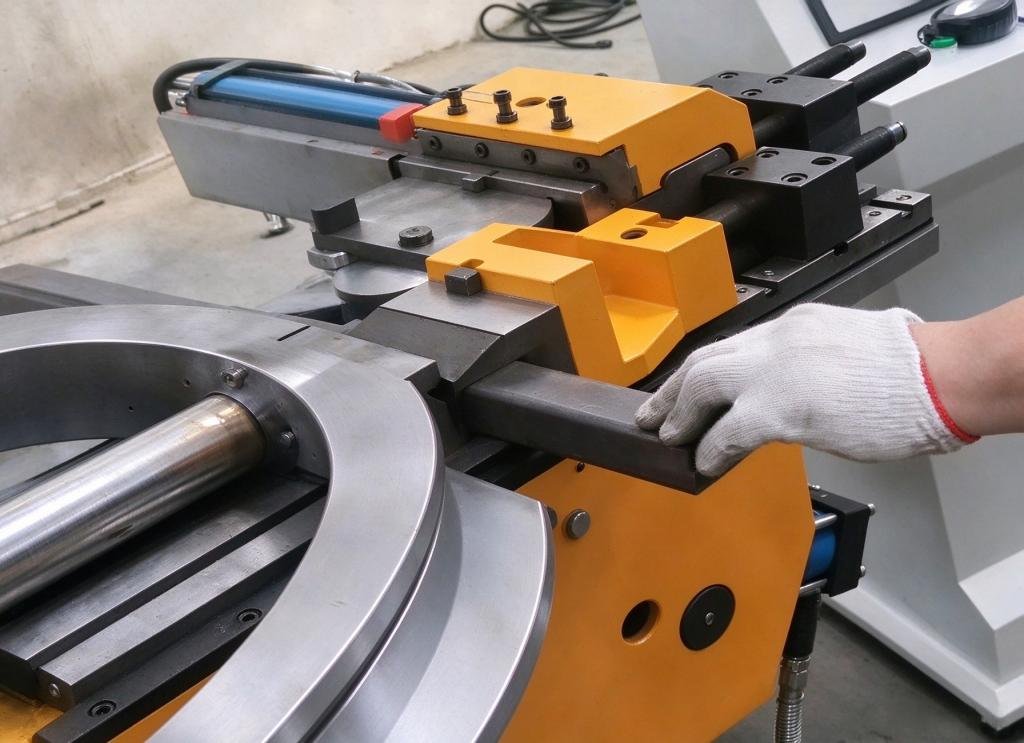
Inner wrinkling is both a cosmetic and a structural problem. The inner wall is in compression; once it buckles, light corrugation appears, and in severe cases the material folds over itself. The answer is a wiper die plus a mandrel: the wiper die holds the inner profile against a rigid support, while the mandrel supports the tube wall from inside the bend and prevents section collapse. Mandrel selection matters — a single-ball mandrel suits medium walls and moderate radii, a multi-ball mandrel (three or four balls) performs better on thin walls at tight radii because it creates continuous support through the bend, and a flexible mandrel covers very large radii or non-circular sections.
Ovalization is the third measure. If the section flattens into an ellipse, fit-up with lugs, bottom brackets and mating parts suffers, weld gaps become uneven, and strength drops directly. Ovalization is typically held within 5 percent. It depends heavily on mandrel diameter, mandrel advance and clamping force: pull the mandrel back too early and the rear half of the bend loses support, so the section collapses immediately.
These three constraints fight each other. A larger mandrel controls ovalization but raises friction and can score the inner wall. Slower bending improves wrinkling but costs throughput. More boost reduces thinning but can pile material in the feed section. Setting up a process means finding that balance point — and then locking it into parameters rather than leaving it in someone’s hands.
Springback Is a Number to Calculate, Not an Adjustment to Feel
Steel, stainless, aluminum and titanium all spring back after bending. The amount depends on grade, yield strength, wall tolerance and bend radius — and even heats of the same material differ.
In the manual era the method was trial bending, measuring the angle, trimming the tooling, bending again, and eventually learning to “add two degrees”. That works for a single specification in small volume. It collapses the moment specifications change often: every change triggers a new trial, and the tubes consumed by trials are the cheaper part of the loss — the downtime is what hurts.
The mature approach writes springback into the program. The controller holds a compensation table grouped by material grade, wall thickness and bend radius, populated with measured springback values, and every bend runs at the compensated angle. The first part is measured immediately, the deviation feeds back and corrects the compensation, and the second part is already inside tolerance. More advanced setups add laser angle measurement and real-time closed loop: measure right after the bend, compensate within the same cycle, and remove trial bending from the flow entirely.
The value is not only the saved tubes. Once first-part acceptance is high, a line can afford to run small batches — and being able to run small batches is what widens the range of orders a plant can accept.
Machine Architecture: From Single-Head Hydraulic to Multi-Axis Servo Linkage
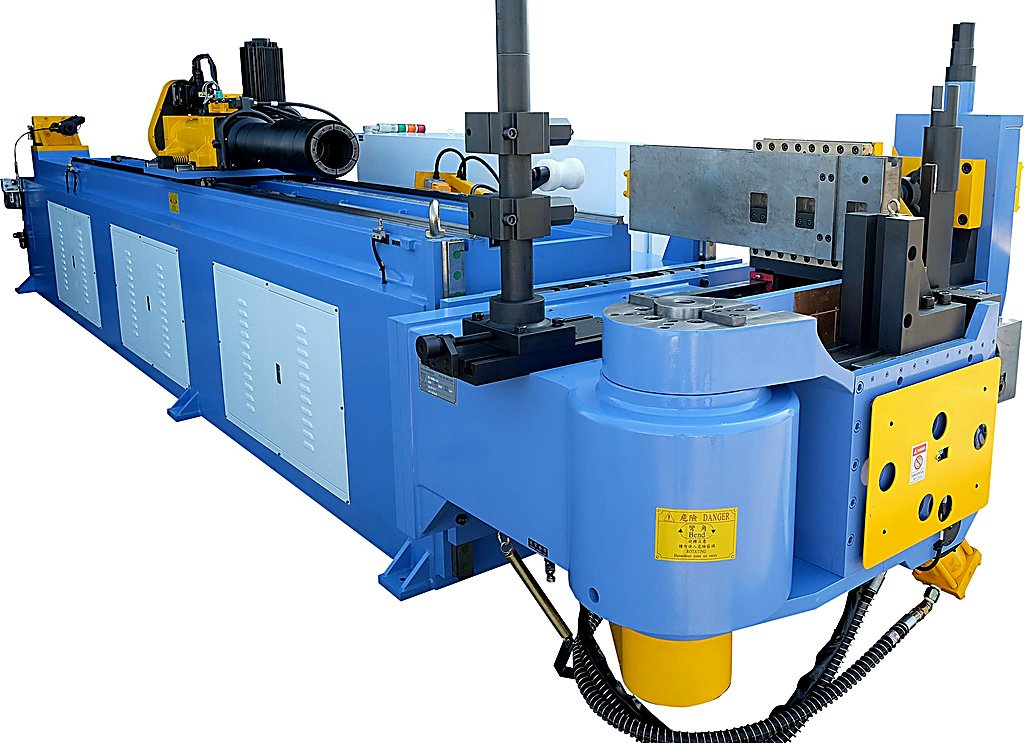
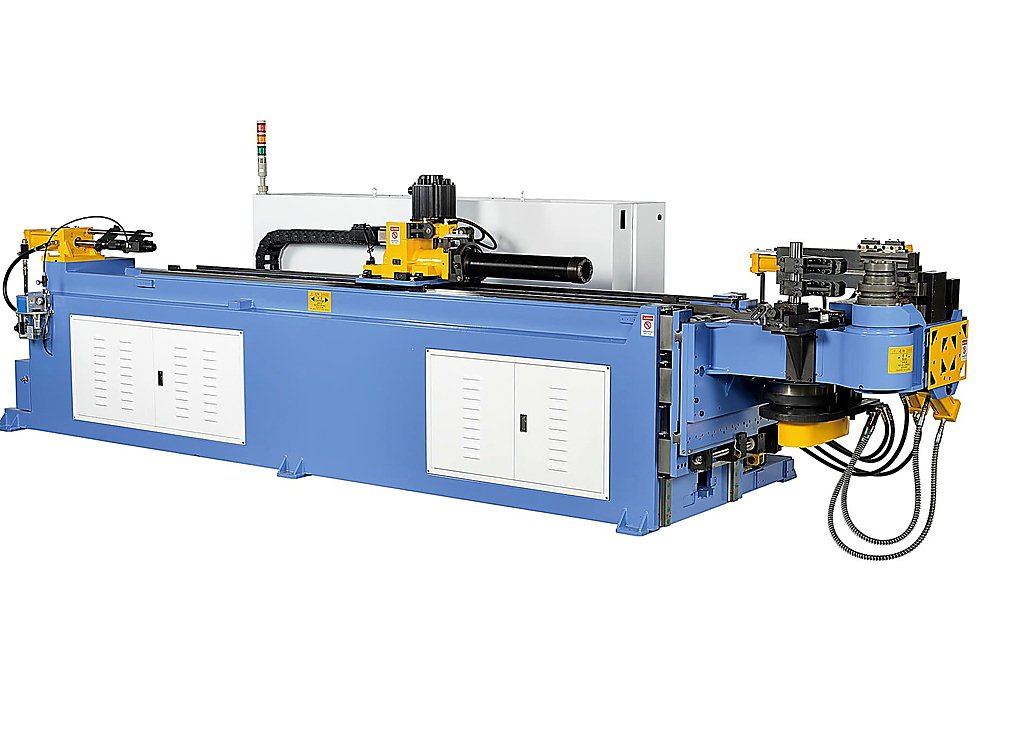
By structure, single-head and twin-head benders dominate frame production. A single-head machine completes every action of one bending center in a single clamping, which suits multi-segment frame tubes. A twin-head machine works two bending heads symmetrically, and for symmetrical parts such as handlebars, racks and baskets the efficiency advantage is obvious.
By drive, hydraulic and servo are the two main lines. Hydraulic machines earn their place with torque, remain hard to replace on large-diameter thick-wall tube, and keep cost relatively controlled — but once oil temperature rises, flow characteristics shift and angles begin to drift after a few hours of continuous work. Valves, hoses and seals are consumables, so maintenance windows come around often. Direct-drive servo machines with high-resolution encoder feedback commonly hold angular repeatability of ±0.05° to ±0.1° and feed accuracy in the ±0.05 mm range, consume 30 to 50 percent less energy than hydraulic systems, and remove hydraulic oil as a variable altogether — which matters more than the electricity on a line producing clear-coated or brushed cosmetic parts.
Where machines really separate is axis coordination. The feed axis handles length, the rotation axis handles orientation in space, the bend axis handles angle, the mandrel axis handles extraction and advance, the booster axis handles material flow, and lift and multi-die indexing add further freedom. If those axes operate independently, complex parts must be split across multiple setups. With linkage, planar bends, S-bends, serpentine bends and three-dimensional bends complete in one clamping. The significance is underrated in bicycle work: every setup eliminated is one less positioning error and one less chance to mark a cosmetic surface.
What Electrification and Cargo Bikes Changed
E-bikes and cargo bikes are reshaping the specification mix. Battery bays, motor mounts and reinforcement structures push tube diameters from the familiar 31.8 mm up past 42, 44 and even 50 mm, while walls climb from 0.9 mm to 1.5 or 2 mm. Larger diameter and thicker wall multiply bending torque, so frame rigidity, clamping force and tooling strength all have to move up with it.
At the same time, cargo front racks, rear racks and child-seat brackets call for long-span, large-radius arcs — low value per part but high volume, which raises the demand on cycle time and automatic feeding rather than on precision alone. Gravel and retro commuter models go the opposite direction: small batches, many colorways, bare tubes shipped as cosmetic parts where a single clamp mark is scrap.
Running both order types in the same plant is entirely normal. Adaptability across that range decides whether a machine is worth its price far more than any single performance figure.
The Temper of Each Material
Carbon steel bends most easily: enough elongation, low springback, forgiving parameters. It remains the workhorse of volume frame production.
Chromoly steel allows thinner walls for the same strength, but higher yield strength brings higher springback, and the compensation table has to be subdivided by heat — otherwise angles drift between batches.
Stainless work-hardens noticeably. The bent zone gets harder, springback is large and unstable, and the process is sensitive to lubrication and bending speed. For brushed or mirror-finish stainless, tool marking has to be solved as well: polished tool profiles, polyurethane pads and reduced clamping pressure are standard countermeasures.
Aluminum springs back heavily and has low elongation, so bend radii cannot be pushed too small or the outer wall simply cracks. Aluminum frames are largely hydroformed or cast, but stays, racks and baskets still rely on tube bending in volume.
Titanium is the hardest of all: very large springback, poor thermal conductivity, rapid local heating, fast tool wear, and often a need for hot bending or incremental small-angle forming. A machine that bends titanium reliably will bend everything else; the reverse is not true.
The Real Efficiency Sits in Changeover and Yield
Plenty of plants calculate capacity from cycle time alone, ignore changeover and yield, and then discover the “theoretical capacity” was never reached.
Changeover is the first hidden cost. A conventional single-layer die set takes one to two hours to swap. With multi-spec, low-volume orders and three changeovers a day, half the capacity is gone. Quick-change structures, pre-mounted die plates, die libraries and recipe management pull that down under ten minutes. Only then does “a dozen specifications a day on one machine” stop being a slogan.
Yield is the second. Manual bending produces a wide angle distribution, and assembly compensates by selectively fitting parts. Program-driven production produces a narrow distribution, so welding fixtures and gauges can be designed to nominal dimensions. Once the tolerance chain tightens, weld distortion, assembly gaps and post-process straightening all shrink together — and that gain usually outweighs the labor saved.
Material utilization is the third. Precise feed-length control minimizes head and tail allowance, and nesting plus programmed cut-off makes the number of parts per six-meter length predictable. On butted thin-wall tubing or titanium, this single item often exceeds the combined savings on power and labor.
A Checklist Worth Going Through Before Buying
Start with the capability envelope, and do not stop at maximum tube diameter. What matters is the actual capability at the combination of maximum diameter, maximum wall and minimum bend radius — and whether thinning and ovalization stay within limits at that combination. Ask for sample parts and measure them; that is more reliable than any catalogue figure.
Then tooling and mandrel configuration. Frame tubing comes in many specifications, so die count and quick-change method become long-term cost. Mandrel type, wiper die, and whether multi-die automatic indexing is supported determine the forming quality of the difficult parts.
Then software. Can a 3D tube model be imported directly, can bend sequence be optimized automatically, is there interference simulation, can the springback library be customized, can programs be written offline and downloaded. These save engineering time during prototyping and downtime during production.
Then acceptance. Put it in the contract: bend fifty consecutive parts and measure angular repeatability; run three sample sets at different radii from one material lot and measure thinning and ovalization; perform three die changes and record actual changeover time. Measurable clauses beat any verbal assurance.
Closing
Bending a bicycle frame is, at bottom, a balance struck inside a very narrow process window: walls thin enough to save weight, radii tight enough to stay compact, surfaces good enough to skip paint, consistency stable enough for automated welding. That window has narrowed past what experience alone can hold, so it now takes machine capability, process parameters and data feedback together.
The direction of travel is clear: bending is turning from a forming step into a data step. Machines record angle, feed length and compensation for every part; that data flows back into the process library, and the next product’s first part lands closer to nominal. When benders in one shop start sharing those parameters with each other, the cost structure of small-batch, high-mix production genuinely changes — and that is probably the most interesting shift in bicycle manufacturing over the next few years.