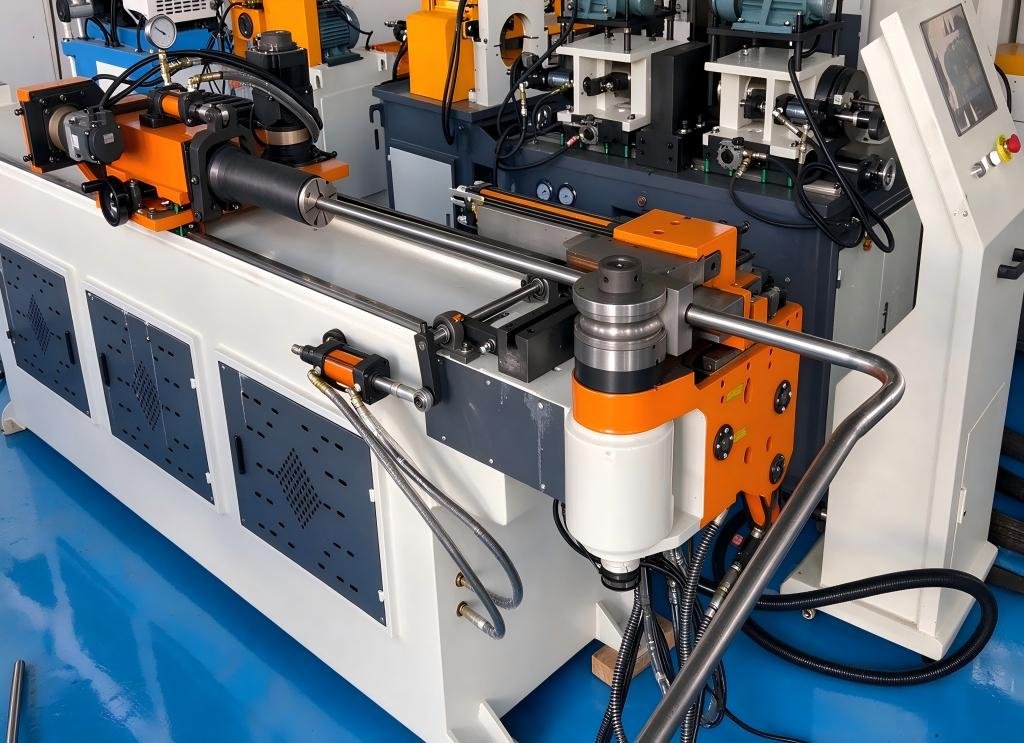
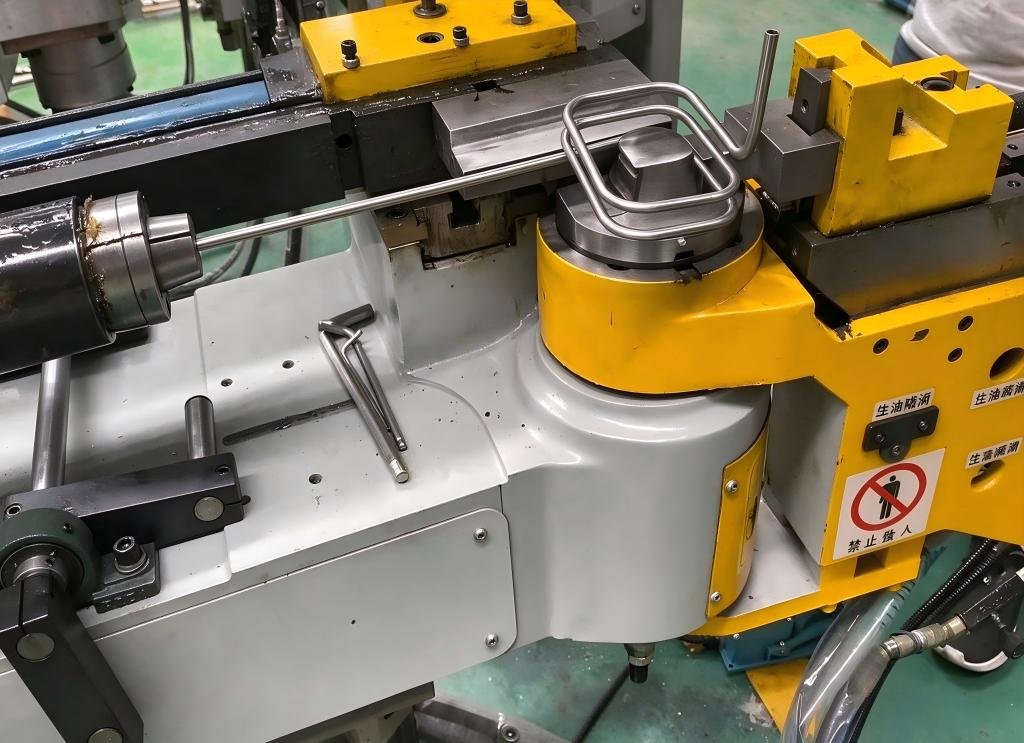
Chair Tube Bending Machine: How Multi-Radius CNC Forming Turns Light Furniture Tube Into Frames That Match
News 2026-11-16
In tubular steel furniture, the sale is rarely decided by the cushion. It is decided by the curves in the frame: the arc of the backrest, the S-shaped transition of the front leg, the way an armrest meets the seat ring. When the curves are smooth, symmetrical and repeatable, the product looks “designed”; when they sag, wrinkle or drift out of symmetry, no upholstery can hide it. That is why an increasing number of steel furniture plants now treat the chair tube bending machine as the first quality gate of the entire production line.
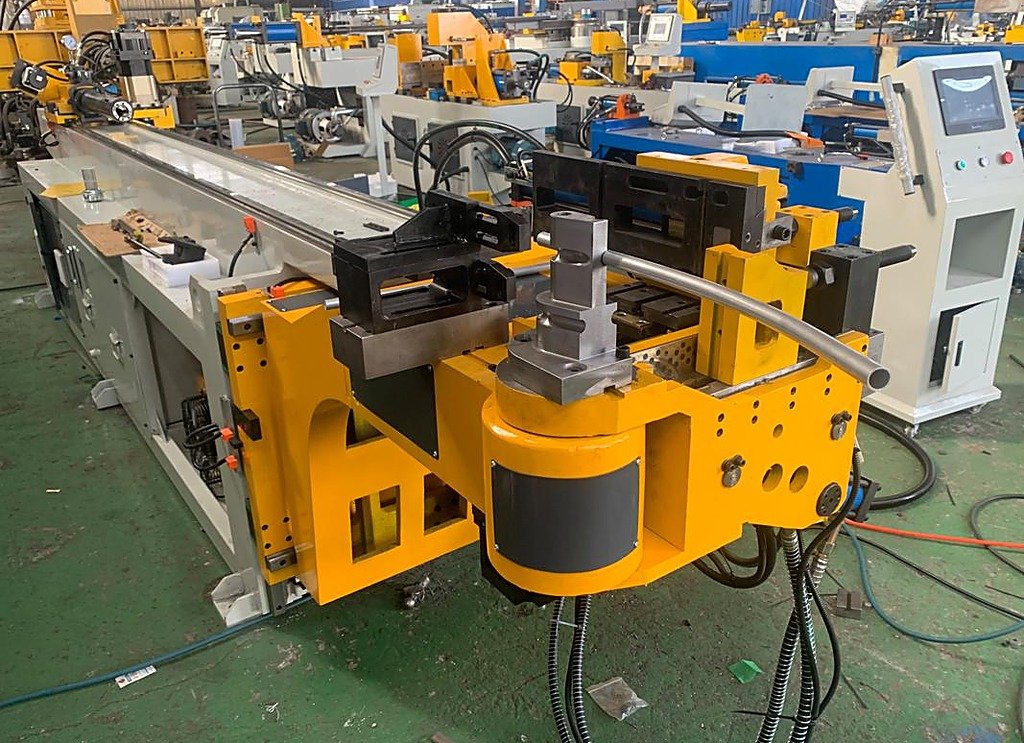
Furniture tube is far less forgiving than structural tube
The tube used for chairs is not the thick-wall steel that structural applications use. What the industry calls furniture tube is usually high-frequency welded pipe in low-carbon grades such as Q195 and Q235, plus some 201 and 304 stainless decorative tube, with outer diameters concentrated between roughly 10 mm and 110 mm and wall thicknesses of only 0.5 to 2.0 mm. The surface must stay bright and pit-free, because it will later be polished, chrome-plated or powder coated.
That combination is hostile to bending. The diameter is modest but the wall is thin, so the cross-section has little stiffness to resist collapse. Where a structural tube passes through a given radius without complaint, furniture tube can bulge and wrinkle on the inside of the arc and thin visibly on the outside. Chair bending is therefore never a matter of pushing a tube into a die; it is a coordinated forming process involving dies, mandrel, wiper die and feed accuracy working together.
The geometry problem: multi-radius, multi-angle, mirrored pairs
The real difficulty of a chair frame is geometric. A typical dining or office chair frame gives the front leg two or three consecutive bends of different radii, while the backrest adds a long shallow arc — and there is almost no straight section between bends to use for positioning. Older processes had to cut one tube into several segments, bend each separately and weld them back together: many seams, long hours, and symmetry left entirely to the operator’s hands.
Modern CNC benders answer with one-piece forming. A stacked (multi-radius) die head carries several bend radii at once, and servo-controlled axes execute feed, rotation and bending in one continuous program. A tube enters at one end and leaves with every bend complete. Positioning between bends comes from servo feed precision instead of hand-marked lines, and the butt welds between segments disappear altogether.
Why thin walls need the mandrel even more
During bending, the inside of the tube is compressed and the outside stretched, so the section tends to flatten. A thin furniture wall cannot hold that deformation by itself: without internal support, the inside of the arc nearly always wrinkles and the section turns visibly oval. Wrinkles are not just cosmetic — they push hole positions out of alignment during assembly, and on chrome-plated parts a single wave is a scrapped piece.
The mandrel supports the wall from the inside at the moment of bending. For thin-wall furniture tube with a high D/t ratio, a multi-ball mandrel is usually chosen so the support points follow the bending zone, working together with a wiper die that holds the wall just before the tangent point and keeps waves from spreading outside the clamp. The mandrel’s tip extension (the advance) is the key tuning parameter: too far and the outer wall tears, too short and the inner wall wrinkles. Both are dialed in through trial bends.
Springback: why the chair arc is always “a little off”
Plants know the symptom well: the drawing calls for an R300 backrest arc, the bent tube measures closer to R350, and once the seat is mounted the proportions of the whole chair change. That is springback — the tube recoils elastically when the load is released. For low-carbon steel tube the angular recoil is usually a few degrees, but on long arcs the radius deviation is amplified.
There are two ways to handle it. The first is manual compensation: make the die radius slightly smaller than the drawing and back-calculate the offset from measured trial bends. The second is program compensation: enter the springback angle into the CNC program so the bending axis overshoots accordingly, with small corrections per material batch. For an industry with many arcs per product and fast model changes, the second approach wins clearly — switching to a new chair model means changing a few parameters, not cutting a new die.
Left-right symmetry is the production lifeline
Every chair has a left and a right frame half, and orders run in sets of four or eight chairs. If the two halves differ by even two or three degrees, the seat twists during assembly, rivet holes miss their positions, and a whole batch goes back for rework. So the critical figure for a chair tube bender is not “how many degrees can it bend” but “what is the repeatability”.
Servo-driven CNC machines dominate here. Feed positioning can be held to fractions of a millimeter, bend angles are closed-loop controlled, and rotation axes paired with left- and right-hand dies produce mirrored parts — the same program, only the die direction changes, and the two halves come out naturally symmetrical. Cycle time stays constant from the first frame to the last, which also removes the “one result with the master setter on shift, another after handover” problem.
The surface is the selling point: controlling scratches and clamp marks
The usual finishing routes run bending → welding/drilling → phosphate pretreatment → powder coating, or bending → polishing → electroplating. Either way, scratches made at the bending stage travel all the way to the finished part: deep scratches show their outline through powder coat, and clamp-jaw marks are magnified by a chrome mirror.
That is why chair-specific benders are more careful than general-purpose ones in clamp and wiper design: wider clamp faces, lower contact pressure, nylon or polyurethane inserts where needed, and die surface finishes and lubrication matched to bright tube. These details are easy to overlook when comparing spec sheets, yet they often decide the plating yield.
One-piece forming takes welds off the frame
Structurally, the biggest contribution of one-piece bending is fewer welds. In the old segment-and-weld process, every circumferential seam is a potential stress concentration and a starting point for corrosion, and weld heat distortion makes the two frame halves drift apart subtly. With whole-tube bending, the frame keeps only the joints between separate tubes; seam count drops sharply, grinding hours fall with it, and pretreatment before coating becomes simpler.
For the cost-sensitive steel furniture trade the arithmetic is direct: the saved weld segments, grinding hours and scrap usually pay back a CNC bender within months. That is exactly why steel chair, office chair, beach chair — and even luggage cart — makers have been retiring hydraulic machines for CNC cells over the past few years.
Whether a frame can be bent in one piece is a numbers question
The industry’s first check is the relation between relative bend radius and wall thickness. Below about 2D (bend radius under twice the tube diameter), wrinkle and thinning risk rises steeply for thin walls; 2D to 3.5D is the usual economical window; beyond 3.5D ovality is easy to hold. Chair styling, however, pushes for tight radii, so the designer and the bender must meet in the middle — or push the limit down with multi-ball mandrels and small-radius tooling.
Wall thinning is the other hard limit. Furniture tube starts at barely one millimeter of wall; excessive thinning on the outer side eats the strength margin, and a seat that is loaded cyclically can crack in the arc. Sound practice is to put ovality, thinning rate and angle tolerance for every critical bend on the inspection sheet — not to rely on eyesight.
Where the weld seam sits matters too
Where budgets still call for longitudinal welded tube, the seam’s orientation must be planned before bending. The seam is the mechanically weakest line in the wall; if it lands in the compression zone on the inside of the arc, it tends to pucker or split along the weld. The standard fix costs nothing: the machine’s rotation axis turns the seam toward the neutral plane, where bending stresses are lowest. Set once in the program, it measurably lifts first-pass yield.
From “can bend” to “bends fast”: automated load and unload
Chairs are a classic volume product — a single order can mean thousands of frame halves. The bender itself forms a part in well under a minute; the real bottleneck is handling. Current best practice pairs the bender with an automatic feeding rack, a takeaway manipulator or in-line cutting, so a cut-length tube goes from loading through forming to cut-off without ever touching the floor, and one operator can watch two machines.
Linked to scan-code job dispatch, the machine also recalls the right program per order, cutting changeover time. For export-oriented furniture plants with many models and small batches, that flexibility is worth more than raw bending speed.
A checklist for buyers
Pulling the points above together, a chair tube bending machine selection can be verified against: multi-radius stacked dies; the number of servo axes and their positioning repeatability; the mandrel package for thin walls (multi-ball mandrel and wiper die as standard); left- and right-hand dies for mirrored parts; program-based springback compensation; clamp design and die finish suited to bright tube; and expansion interfaces for automated loading. Walking through that list predicts real production performance far better than comparing maximum capacity and price alone.
Closing
Competition in tubular steel furniture has shifted from style to detail, and the curves of a chair frame are where the details concentrate. A properly set-up chair tube bending machine turns wrinkling, springback and asymmetry from shop-floor headaches into a few parameters inside a program, and keeps every batch of frames at the same arc from the first tube to the last. For furniture manufacturers, that is no longer an optional upgrade — it is the process foundation needed to deliver the designer’s drawing intact to the end customer.