CNC vs NC Pipe Bending Machine: What Is the Difference?
News 2026-09-11
The difference between a CNC and an NC pipe bending machine is easiest to see between bends. Both machines can control a bending angle. The real question is what happens next: does an operator measure, feed and rotate the tube, or does the machine position it automatically?
For buyers comparing quotations, the labels can be confusing. Some suppliers use “automatic,” “NC” and “CNC” loosely, and a hydraulic machine may be either NC or CNC. This article explains the practical difference, where each type performs well and which details should be confirmed before ordering.
CNC vs NC in one sentence
An NC pipe bending machine normally controls the bend angle and stores bend settings, while feeding and rotation are performed manually. A CNC tube bending machine normally programs and coordinates several axes, including bending, feeding and rotation, so it can complete a multi-bend part with much less manual positioning.
This is a market convention rather than a universal naming law. Always request an axis list. A quotation should state which movements are powered, which are programmable and which require the operator.
A three-bend part shows the difference
Consider a tube with three bends. The first bend is 45 degrees. The tube then moves forward 300 mm, rotates 90 degrees and bends again. After another feed movement, it receives a final 60-degree bend.
On a typical NC machine, the control can store the three angles, but the operator may need to mark or measure the feed distances and rotate the tube using a fixture or scale. Good parts are possible, especially with an experienced operator and a reliable positioning system. However, a small error after the first bend affects every feature that follows.
On a CNC machine, the feed carriage moves the tube to the programmed position and the rotation axis turns it to the programmed plane. The bending head then completes the next angle. The program repeats the sequence for each part. This is why CNC is usually selected for three-dimensional automotive pipes, exhaust components, seat frames and other parts with several bends.
Practical comparison
| Factor | NC pipe bender | CNC tube bender |
|---|---|---|
| Bending angle | Programmed | Programmed |
| Tube feeding | Usually manual | Usually servo-controlled |
| Tube rotation | Usually manual | Usually servo-controlled |
| Best part type | Simple, mainly one-plane components | Multi-bend and three-dimensional components |
| Operator influence | Higher | Lower after setup |
| Changeover | Simple for basic jobs | Programs can be recalled for repeat orders |
| Initial investment | Generally lower | Generally higher |
| Automation options | Limited | Easier to integrate with loading, cutting or unloading |
NC does not mean low quality
An NC machine can be the correct production tool. A furniture factory making U-shaped chair bases, a repair shop producing replacement pipes or a fabricator handling frequent small orders may not benefit from automatic feeding and rotation. With mechanical stops, positioning fixtures and clear work instructions, an NC bender can produce stable, economical parts.
It may also be easier for a new operator to understand a simple bending cycle. Tool changes are accessible, and the initial equipment cost is lower. If every part requires only one or two bends, the time saved by CNC positioning may not recover the additional investment.
The weakness appears when manual steps multiply. Long parts become difficult to handle. Rotations in different planes are harder to repeat. Output can vary between operators, and inspection may need to be more frequent. These costs belong in the purchasing calculation.
Where CNC earns its cost
CNC becomes valuable when geometry, volume or labor makes manual positioning the bottleneck. Typical examples include automotive fluid and structural tubes, exhaust systems, motorcycle frames, bicycle racks, complex furniture members and fitness-equipment frames.
The main benefits are repeatable feed lengths, controlled rotations, stored programs and a consistent sequence. If springback changes, compensation can be adjusted in the relevant bend rather than asking each operator to correct it by feel. For repeat orders, the factory can recall the qualified program and setup record.
However, CNC accuracy is not the same as finished-part accuracy. The final component is also affected by tube tolerances, weld seam, tooling wear, clamping, mandrel position, lubrication and springback. A servo axis can move to its target and still produce a poor tube if the process around it is wrong.
Hydraulic, electric and CNC are not opposite categories
A common purchasing mistake is to compare “hydraulic” with “CNC” as if one describes the same thing as the other. Hydraulic refers to how a machine produces motion or force. CNC refers to how its axes are controlled. A CNC bender may use hydraulic clamping and a hydraulic bending axis while using servo motors for feeding and rotation.
Likewise, a machine described as “electric” may still use pneumatic or hydraulic functions for clamping or mandrel movement. Ask for a functional description instead of relying on one marketing term. Jiuqiang’s separate hydraulic and CNC buying guide explains this distinction in more detail.
Compare the axis list, not only the machine name
A basic CNC tube bender may be described as 3-axis: bend, feed and rotate. Additional controlled axes can manage left-right bending, tooling stacks, vertical movement, boosting or other functions. More axes are useful only if the component needs them.
Ask the supplier to provide a written list containing:
- axis name and function;
- servo, hydraulic or pneumatic drive method;
- programmable range and working travel;
- number of tool stacks and available radii;
- mandrel and wiper-die arrangement;
- program storage and backup method;
- loading and unloading method;
- included safety guarding and interlocks.
How to choose between NC and CNC
Choose NC when:
- parts have one or two bends and mainly stay in one plane;
- batch sizes are small or product changes are frequent;
- manual feed and rotation can be controlled with stops or fixtures;
- labor availability is stable;
- the lower initial investment is important.
Choose CNC when:
- parts contain several bends or three-dimensional rotations;
- the same components are produced repeatedly;
- left-right or batch consistency is critical;
- long tubes are difficult to position manually;
- labor reduction or future automation is part of the plan.
If the decision is still close, calculate the cost per acceptable part. Include operator time, inspection, setup, scrap and downstream fixture correction. A CNC machine may produce more pieces per hour but take longer to justify when orders are irregular. An NC machine may be cheaper initially but expensive when several operators are required on every shift.
Do a sample test before deciding
Choose a representative difficult part and define the acceptance criteria before the test. Supply the normal production material, not an easier substitute. Measure bend angles, distances, rotations, ovality, wrinkles and surface marks. Then repeat enough parts to judge consistency.
For an NC trial, include the manual locating fixtures that will be used in production. For a CNC trial, record the program and tool settings so the test can be reproduced. Also place the finished part in the welding or assembly fixture; individual dimensions can look acceptable while accumulated error prevents a good fit.
Jiuqiang NC and CNC tube bending solutions
Jiuqiang manufactures NC, CNC, hydraulic, semi-automatic and fully automatic tube bending equipment. The machines are used for stainless steel, carbon steel, aluminum, copper and other metal tubes in automotive, exhaust, furniture, bicycle, shipbuilding and related industries.
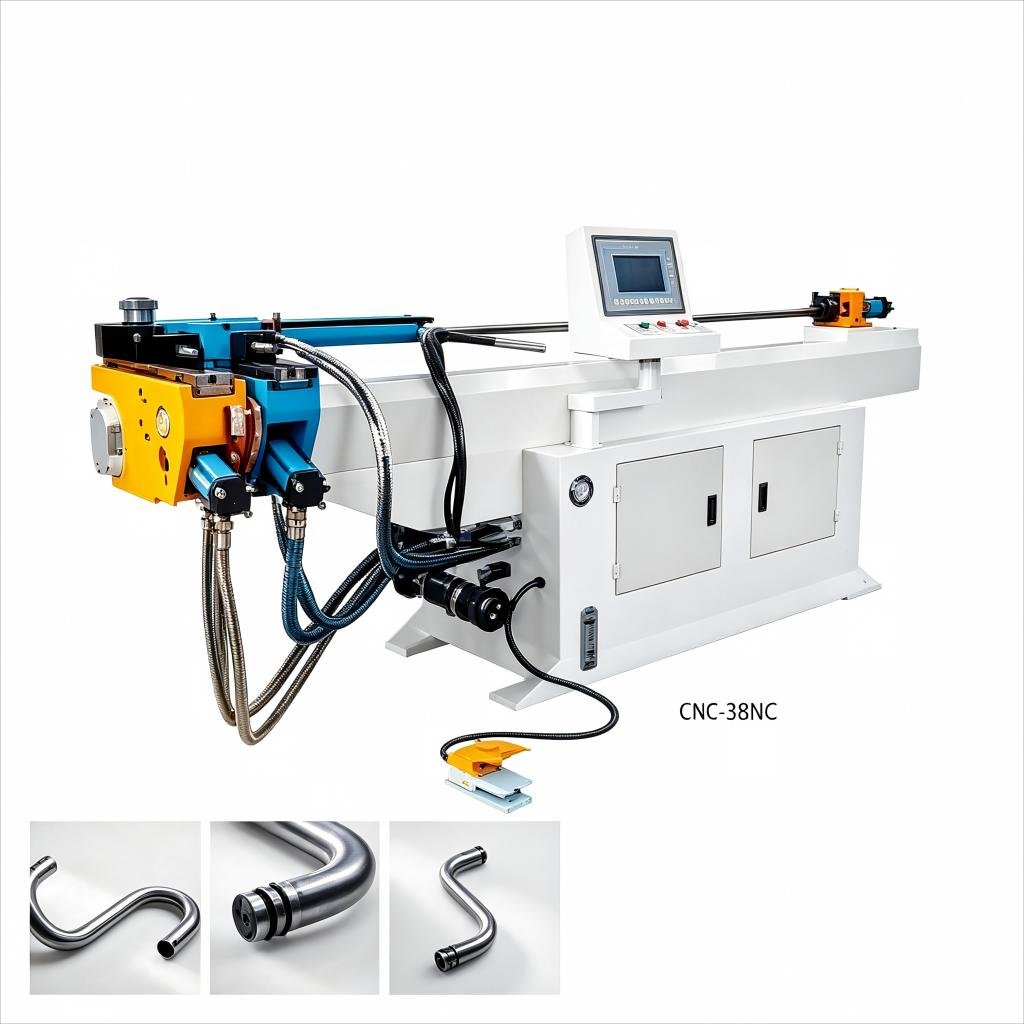
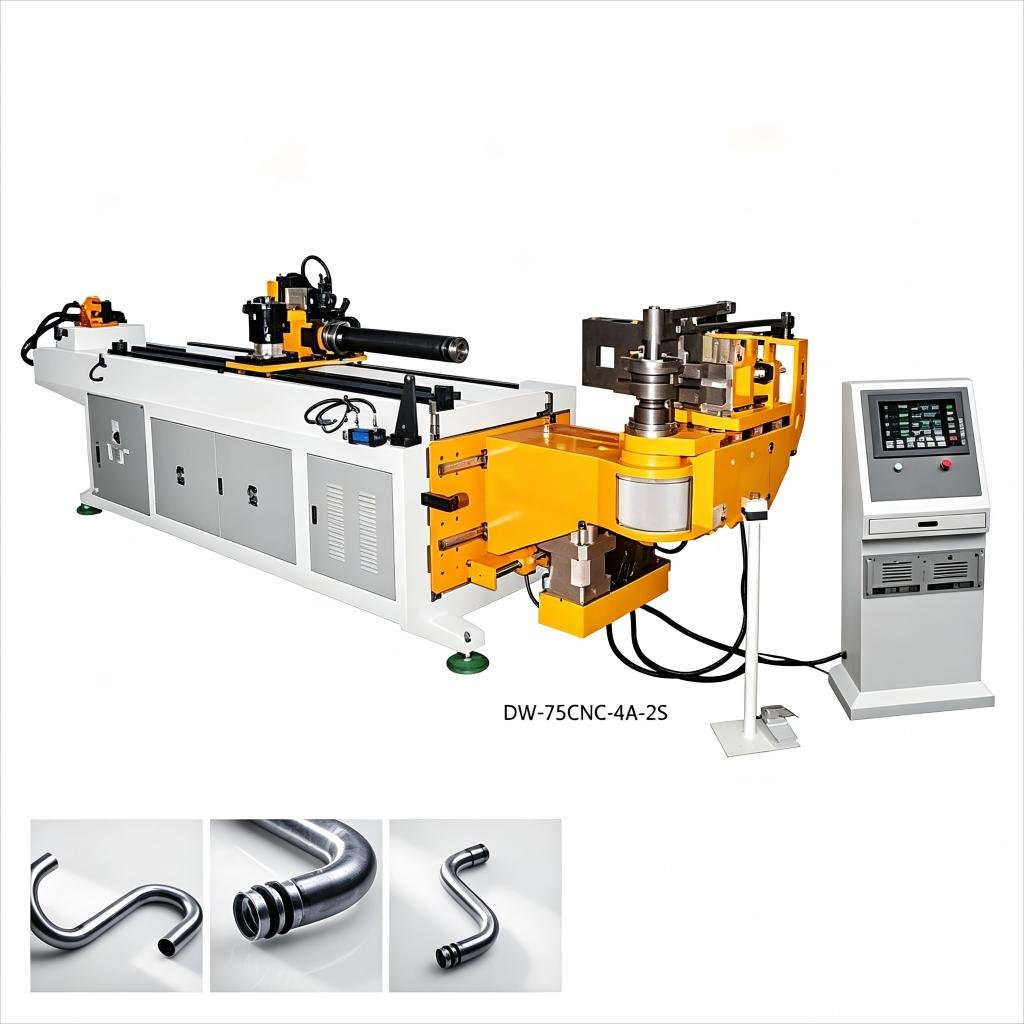
For a practical comparison, review the Jiuqiang CNC-38NC mandrel pipe bender and the DW-75CNC automatic tube bender. Model names alone are not enough; Jiuqiang checks the material, diameter, wall thickness, radius, bend sequence and required output before confirming a configuration.
Jiuqiang equipment is produced under ISO-certified quality procedures and supplied with CE certification. The company exports machines to Mexico, Vietnam and other international markets. Send drawings and production targets through the contact page to receive an NC or CNC recommendation based on the actual component.
Frequently asked questions
Is an NC pipe bender the same as a manual machine?
No. An NC bender normally controls the bending angle and cycle, even though feeding or rotation may be manual. A purely manual machine relies more heavily on the operator for the bending movement itself.
Is CNC always more accurate?
CNC improves repeatability of feed, rotation and programmed movement. Finished accuracy still depends on material, tooling, clamping and springback control.
Can an NC machine use a mandrel?
Yes. Control type and mandrel use are separate decisions. An NC mandrel bender can produce thin-wall or tighter-radius parts when the machine and tooling are correctly configured.
Can I upgrade an NC machine to full CNC later?
Minor automation may be possible on some designs, but converting the feeding and rotation system is usually more complex than adding software. If future CNC production is likely, discuss it before purchase.